
Avalanches are crucial for glaciers worldwide
An international research team has shown that avalanches are crucial to the survival of many glaciers around the world. The study aims to contribute to better predictions of water resources and natural hazards in connection with global warming.





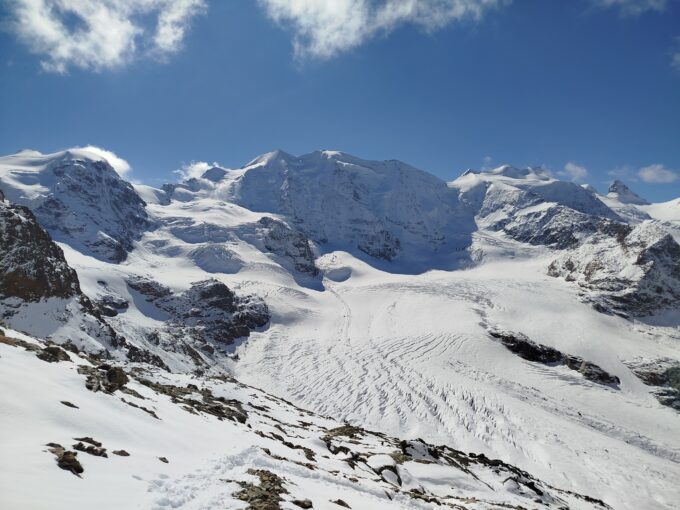
Glaciers remain stable when the snow that falls on their surface compensates for melting at lower altitudes (see box*). In our warming world, this balance has been upset and glaciers are shrinking—with consequences for water resources and natural hazards. «To understand how glaciers will develop in the future, it is important to know how much snow falls on their surface,» says Marin Kneib, glaciologist at WSL and ETH Zurich.
One factor that has been little studied to date is avalanches. Observations of individual Alpine glaciers have shown that up to 20 percent of the snow that falls on them comes from this source. Now, Kneib and an international research team have estimated the influence of avalanches on all 200,000 glaciers on Earth – and were surprised by their findings. ’I never would have thought that this effect would be so significant on a global scale,« says Kneib.
Snow slides onto the glaciers
On average, 11 percent of the snow on Alpine glaciers comes from avalanches, while in the eastern Himalayas the figure is 19 percent and in New Zealand, which tops the list, it is as high as 22 percent. On individual glaciers, more than 50 percent of the snow can come from avalanches. In flatter mountain ranges such as those in Iceland or Greenland, however, avalanches play hardly any role. The results are published in the journal Nature Communications published.
Avalanches are beneficial for small glaciers: thanks to them, these glaciers could survive longer than researchers had expected, despite climate change. In the Alps, forecasts show that glaciers smaller than one square kilometer—such as the Läntagletscher on the Rheinwaldhorn—would lose three times less ice than previously assumed, at least in the most favorable climate scenario. This is because the smaller glaciers become, the greater the influence of avalanches, as these mainly fall on the edges of the glaciers. «The significance of avalanches on glaciers will therefore increase in the future as the glaciers retreat,» says Kneib. But this is no salvation: «In the Alps, we will lose more than 80 percent of the ice volume of the year 2000 by 2100 anyway.»
Furthermore, avalanches do not always bring snow. They can also remove large amounts of snow from glaciers if these are steep enough. In the tropical Andes, for example, eight percent of snowfall slides off the ice in avalanches, snow that is then missing from the glacier. Avalanches also remove snow from steep ice flanks at high altitudes. With the warming of the climate, the ice in these areas is likely to disappear sooner than expected, which in turn threatens to destabilize the rock below.
Understanding water resources
For the study, the research team combined two models: a global glacier model and a model that calculates how snow masses move (snow transport). Glacier models are based on satellite measurements of the ice surface and provide a good representation of the global ice volume. But it was the snow transport model that revealed the significant local impact of avalanches. «If we have a better understanding of the future of individual glaciers in steep mountain regions, we can better model the runoff into the valleys.» This, in turn, has implications for hydropower, natural hazards, and agriculture.
The study aims to inspire a new generation of refined glacier models. «This is only an initial estimate of a process that has been little studied to date,» says Kneib. However, in order to refine the models and thus the forecasts for individual glaciers and catchment areas, more measurement data on avalanches from on-site observations and remote sensing is needed.
*How do glaciers develop?
Glaciers in the mountains generally increase in mass when snow falls at higher altitudes. The snow solidifies into ice and flows downhill with the glacier's current to lower altitudes, where it melts more quickly. A glacier is therefore the result of a balance between snow accumulation and ice melt (mass balance). In steep mountain regions, avalanches can transport large amounts of snow onto glaciers regardless of altitude and in some cases even protect them from melting at low altitudes.
Source: WSL