New generation of «FireDrone» for fire departments and industry: It goes where it's hot
Die «FireDrone» soll Echtzeitdaten aus Hochrisikobereichen liefern, die für Menschen und herkömmliche Drohnen zu gefährlich sind. Entwickelt an der Empa und weitergeführt als Spin-off, kombiniert die neue Generation der Drohne hitzeresistente Materialien mit praxisnaher Robotik – für Brandeinsätze und Industrieinspektionen bei extremen Temperaturen.





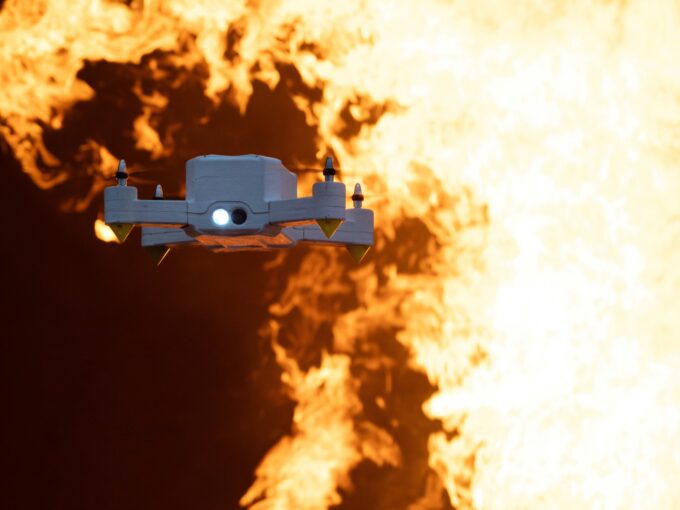
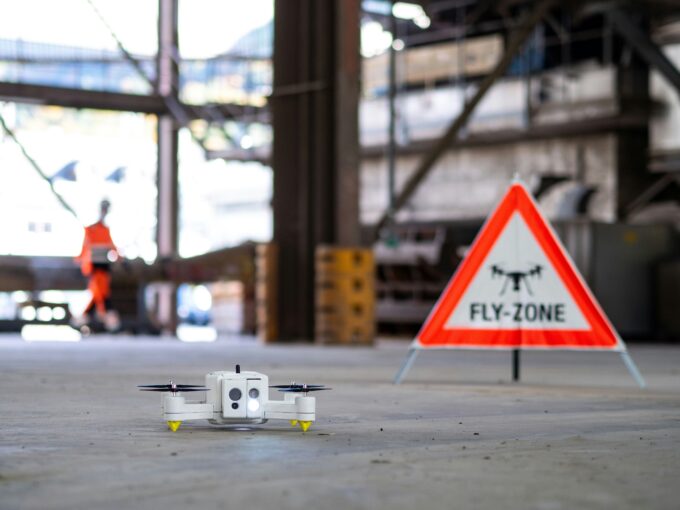
Firefighting in large buildings, long tunnels or extensive forests poses major challenges for emergency services. The FireDrone is designed to provide a quick overview: As the first heat-resistant drone, it flies into high-risk environments and provides situational information in real time. «Today, firefighters have to enter burning buildings themselves in order to locate hazardous materials or missing persons. With the FireDrone, we can send a drone into hazardous areas for the first time to do just that - and thus significantly minimize the risk of firefighting operations,» says Fabian Wiesemüller, Empa researcher and co-founder of the start-up company. The flying robot was developed at Empa and is now being continued by an Empa and EPFL spin-off. In the future, it will support firefighters in making quick and well-founded decisions.
Used by fire departments and industry
Toxic smoke, collapsing components or exploding materials endanger firefighters. Smoke and pollutants are responsible for more than two thirds of deaths in firefighting operations, and over a third of all operations involve hazardous materials. The FireDrone should therefore be used in confined spaces or dense clouds of smoke. Its strength lies above all in its use within large and complex structures such as industrial halls, parking garages or tunnels. Searching these areas is particularly time-consuming and dangerous. «A drone that can fly over such areas quickly and undamaged brings clear added value,» says David Häusermann, Empa researcher and co-founder of the start-up.
In addition to fire missions, the drone is also suitable for industrial inspections. Many plants with furnaces, refineries or chemical processes can only be safely inspected after long cooling phases. These downtimes often last several days, cause high costs and lead to energy losses. In future, the FireDrone could be used to inspect cement or steel plants and waste incineration plants during operation - wherever high temperatures make it difficult to use humans and conventional drones.
Progress with insulation
Conventional drones stop flying at around 40 degrees Celsius: the frame deforms and the electronics fail. The FireDrone, on the other hand, flies at temperatures of up to 200 degrees Celsius. It is protected by patented insulation made of ultra-light aerogel. This consists almost entirely of air-filled pores that are enclosed in a heat-resistant plastic.
Compared to earlier versions, the insulation system has now been fundamentally simplified. Instead of a complex, glass fiber-reinforced composite structure made of polyimide and silica, a pure polyimide aerogel is now used. «We can cast the aerogel in three-dimensional shapes and customize it to the drone,» says Häusermann. Bulky individual components for the shell are now a thing of the past: the new material encases the sensitive components in a single cast.
At the same time, Empa researchers led by Shanyu Zhao continued to improve the high-temperature-resistant polyimide aerogel. Such materials were long considered difficult to realize. Years of research into the chemical composition - from the selection of starting materials to polymerization and solvent processes - resulted in a new material combination that combines high heat resistance with mechanical flexibility. In addition, the FireDrone has an internal temperature management system that continuously cools and monitors the electronics.
Live thermal images from buildings
Equipped with an infrared camera, the FireDrone transmits high-resolution thermal images in real time to the remote control screen. This allows several firefighters to locate the source of a fire or missing persons at a safe distance at the same time. «Today, often only the first firefighters in the building can see what it looks like inside. With the drone, the incident commander, for example, can get his own overview even before people enter the building,» explains Häusermann. The drone can optionally be equipped with additional cameras or sensors, for example to measure outside temperatures or detect gases that are produced during fires.
Another decisive advantage is that the FireDrone can also fly indoors. As it cannot rely on satellite navigation, it has been specifically optimized for use in buildings, tunnels or covered industrial facilities. «GPS is not available in many of our deployment scenarios. That's why we are developing pilot assistance and localization systems that work reliably even without a satellite signal,» says Wiesemüller.
The spin-off has already tested the FireDrone several times on the training grounds of the Andelfingen training center and at Holcim's cement plant in Siggenthal. «Tests are crucial in order to make the step from the laboratory into practice. In future, pilots should be able to use these drones safely in extreme situations with minimal training,» says Häusermann. In the long term, the FireDrone is to be supplemented with a mobile docking and maintenance station that can be integrated into fire engines or modern fire protection systems.
Source: EMPA