
Allianz Risk Barometer: Cyber remains top risk worldwide, while AI risks jump to 2nd place
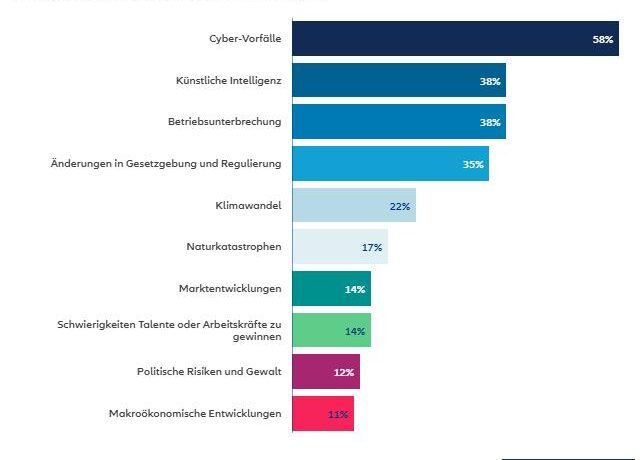
Allianz Commercial publishes its 15th annual «Allianz Risk Barometer» survey on the most important business risks worldwide. Cyber incidents and business interruptions are in first and third place globally and in Switzerland, followed by AI risks in second place, both globally and in Switzerland.






3338 people from 97 countries took part in the survey.
In third place worldwide are natural disasters (CH: 6), while in Switzerland changes in legislation and regulation are still a headache for companies in fourth place.
Cyber incidents made numerous headlines in 2025 and, according to the Allianz Risk Barometer will remain the biggest concern for companies worldwide in 2026. Last year was also a significant year for artificial intelligence (AI). The fact that the risk landed in second place in the ranking and made the biggest leap (CH: 2nd place) underlines the complexity of AI as an operational and legal risk, but also as a threat to the reputation of companies. Nevertheless, almost half of those surveyed believe that AI brings more benefits than risks to their industry.
One fifth are of the opposite opinion. For the first time ever, business interruption (BI) is no longer one of the top two risks, falling back to third place (CH: third place). However, business interruption remains an important topic, as it is often a consequence of other risks in the global top 10.
Factors such as a calmer hurricane season in 2025 mean that natural catastrophes fall to 5th place (CH: 6th) compared to the previous year. Meanwhile, political risks and violence climb from 9th to 7th place (CH: 9th). The main reason for this is the increasing concern about geopolitical instability and conflicts around the world. It is interesting to note that this risk did not make it into the top 10 risks in Switzerland last year.
Thomas Lillelund, CEO of Allianz Commercial, comments: «2025 was characterized by volatility and uncertainty. This year, companies continue to face a rapidly changing environment with interconnected and highly complex risks. Given the continued rise of AI in society and business, it is not surprising that it features prominently in the Allianz Risk Barometer. AI not only brings with it enormous opportunities, but is also changing the risk landscape through its transformative potential and rapid development and spread. Alongside other more established threats, it is therefore becoming a prominent topic for companies of all sizes worldwide.»
Cyber risks are by far the biggest challenge for companies
In 2026, cyber incidents will be the biggest risk worldwide for the fifth year in a row. 42% of respondents worldwide rate cyber as a top risk. This is the highest figure ever achieved. Cyber is also ten percentage points ahead of the second biggest risk at 32 percent. Cyber risks are the top risk in every region of the world (Americas, Asia-Pacific, Europe, Africa and the Middle East). The continued top ranking in the Allianz Risk Barometer reflects the increasing reliance on digital technology at a time when the Cyber threat landscape and the geopolitical and regulatory environment are changing rapidly. Recent high-profile cyberattacks underline the ongoing threat to companies of all sizes. Small and medium-sized companies are increasingly being targeted by criminals, mainly due to a lack of resources for cyber security, and are under massive pressure.
«The investments made by large companies in cyber security and resilience have paid off and ensure that they can detect and respond to attacks at an early stage. However, cyber risks are constantly evolving. Companies are increasingly reliant on third-party providers for critical data and services, while AI is amplifying threats, increasing the attack surface and exacerbating existing vulnerabilities,» explains Michael Bruch, Global Head of Risk Consulting Advisory Services at Allianz Commercial.
AI creates new opportunities and risks
AI has risen to the top group of global corporate risks and is in second place in 2026 (32%) compared to 10th place last year. This is the biggest jump in this year's ranking. AI is an important factor in all regions - in second place in the Americas, Asia-Pacific, Africa and the Middle East and in third place in Europe - and is also a growing risk for companies of all sizes. It has moved into the top 3 for large, medium and small companies. As the adoption of AI accelerates and the technology becomes more deeply embedded in core business, respondents expect AI-related risks to increase, particularly with regard to liability issues. The rapid spread of generative AI systems in conjunction with their increasing use in practice has heightened awareness of the extent to which companies are exposed to these risks.
«Companies increasingly see AI not only as a powerful strategic opportunity, but also as a complex source of operational, legal and reputational risk. In many cases, adoption is progressing faster than governance, regulation and corporate culture can keep up,» says Ludovic Subran, Chief Economist at Allianz. «In 2026, more and more companies will seek to expand their use of AI. They will increasingly face problems with system reliability, data quality, integration hurdles and a lack of qualified specialists. At the same time, new liability risks will arise in connection with automated decision-making processes, biased or discriminatory models, the misuse of intellectual property and uncertainty about who is liable if results generated by AI cause damage.»
Business interruptions closely linked to geopolitical risks
2025 marked a shift towards protectionist trade policies and trade wars that unsettled the global economy. It was also a year of regional conflicts in the Middle East and the ongoing war in Ukraine. There were also border disputes between India and Pakistan, between Thailand and Cambodia and civil wars in Africa - a trend that will continue in 2026 with the US intervention in Venezuela. Geopolitical risks are putting increasing pressure on supply chains, but despite rising risks, only three percent of respondents to the Allianz Risk Barometer rate their supply chains as very resilient. In the past year alone, trade restrictions have tripled and affect goods worth an estimated 2.7 trillion US dollars - almost 20 percent of global imports according to Allianz Trade. This is prompting companies to pursue trends such as friendshoring and regionalization. These developments lead to a high perception of risk: 29% of respondents rate business interruptions as the greatest risk. This is 3rd place in the ranking compared to 2nd place in the previous year.
Given the current geopolitical situation, it is not surprising that political risks and violence climbed two places to 7th place - the highest ranking since the Risk Barometer was launched. The closely related risk of legislative and regulatory change - including trade tariffs - ranks 4th globally, unchanged from the previous year but with a higher percentage of respondents reflecting concerns about increasing protectionism. In fact, 51% of respondents consider a paralysis of global supply chains due to geopolitical conflict to be the most likely «black-swan» scenario that could occur in the next five years.