Andri Jost takes over management of the Academy Support Center of the Swiss Safety Center Academy
The Swiss Safety Center Academy is pleased to announce the appointment of Andri Jost as the new Head of the Academy Support Center. Together with his team, he will support course participants from registration to the dispatch of certificates.
Editorial - December 12, 2024
Photo: zVg
As head of the Academy Support Center, Andri Jost is responsible for a wide range of tasks, from course administration and room rental to personal certification, and ensures that you as a customer receive the best possible support.
Continuous improvement as a driving force
Andri Jost is committed to the continuous improvement of processes. This is reflected in the quality and professionalism of the advice and support provided, with the aim of offering course participants a special experience every time they contact the Support Center.
Trust and management experience as a basis
Reliability and trust are values that, together with his many years of management experience, promote stability and growth at the same time. A combination that strengthens the team and also benefits customers.
The aim is to move safely into the future with a comprehensive range of training and development courses.
Source: akademie.safetycenter.ch
Industry trend video surveillance
The video surveillance industry is looking to a positive future. Cost pressure and economic uncertainty are driving demand for innovative and efficient solutions.
In times of high inflation and a weak economy, companies and government organizations are looking for cost-effective solutions to maintain security standards. This leads to an increased demand for affordable yet reliable surveillance systems. The tense economic situation is therefore rather positive and should be seen as a market driver for manufacturers of security systems and their sales figures. This is because the crime rate rises in difficult economic times, which in turn leads to companies or large organizations investing more in security.
Less budget, more AI?
This trend is confirmed, for example, by a survey conducted by the British platform IFSEC (International Fire and Security Communication). Various industry representatives and entrepreneurs were asked about different topics relating to video surveillance. One of the questions asked was whether the current economic situation in England is influencing plans to introduce or upgrade video surveillance systems. The analysis shows that 87% of the companies or other stakeholders surveyed would have re-evaluated projects to some extent, but would still have implemented the planned video surveillance in the end. At the same time, budget constraints could lead to an increased demand for AI-supported video analysis as a supplement to human surveillance. In this environment, manufacturers need to innovate to offer affordable options that still ensure security.
People not yet replaceable
Will this make control centers or control center employees superfluous? Is it to be feared that jobs will be lost as a result of AI? The advantages of AI and "normal" analysis software are obvious. They are able to search huge amounts of data for a specific search term in just a few moments and learn in the process. But this is often not enough. This is because the results of state-of-the-art search tools often only provide the user with suggested results that are highly likely to match the search term entered. Results that fall below a defined threshold value are not even displayed to the user.
At the end of the process, there is still the human being who has to put the filtered results into context. For example: Was the alarm triggered by the activity of a cleaner or is this area not cleaned by a cleaner at all and it is a burglary? Trained people who know the surveillance area can quickly put this into context and make a decision. AI or other software will not be able to do this in the foreseeable future - we have not yet seen anything like this at trade fairs or in practice.
Deepfakes as a problem
Despite all the euphoria about AI and its advantages, the other side of the coin must also be pointed out: For video images in general, all variants of so-called deepfakes in particular are a major problem. The author has asked ChatGPT to formulate a definition of deepfake:
"Deepfake technology is a form of AI that uses deep learning algorithms to create extremely convincing, often deceptive, fake videos or audio recordings. Similarities and characteristics of one person are superimposed on those of another, often resulting in realistic but completely fictitious content."
The damage potential of such deepfake videos is enormous. Statements by leading politicians can be deceptively faked and made accessible to a mass audience via social media platforms such as TikTok. Most recently, a commercial for the BILD newspaper on free-to-air television was even generated using deepfake technology and shown to the public. Although this commercial contained a small notice that it was a video generated using deepfake, this notice could easily be overlooked. The consequences can be serious. Deliberately faked videos aim to manipulate statements made by well-known personalities in order to misuse their popularity for opinion-forming statements and reach. Because where this is deliberately used, there is certainly no separate reference to the use of deepfakes. The author was able to see for himself how a humorous, satirical video uploaded to the social media platform TikTok using deepfake technology was taken as true or real by numerous users, who vented their anger via the video's comment function. Things got really suspicious when users who used the comment function to spread the word that it was not a real video were called conspirators by other users because they had not recognized or did not want to recognize that it was actually a deepfake video.
Video market must catch up on security
The consequences for operators and owners of video surveillance systems who have previously relied on video footage as irrefutable evidence are serious. If CCTV systems are not state of the art, deepfakes have the potential to undermine the credibility of video footage as evidence and its value as a deterrent. In court, the defense could challenge the veracity of the video evidence and attempt to question its timing and authenticity.
As this technology is already accessible to the masses, the video market must follow suit with security measures. The author therefore recommends the exchange of certificates and security protocols between the cameras, the network and the image storage. The operator or owner of such a system must ensure that they can prove that the image from the camera is actually the same image that is stored on the image storage device and is currently being played back. The export process plays a decisive role here. The exported video file must contain all the metadata of the original file from the image memory. In addition, timestamps with the exact date and time to the second must be included in the video image. Furthermore, the systems must not be easily accessible from the outside. State-of-the-art measures such as firewalls, fixed MAC addresses and IP addresses as well as limitations and secure remote maintenance access must be implemented. In the best case scenario, the network on which the video surveillance system runs should be completely sealed off from the outside world.
Declining acceptance of cloud technology
Another trend in the industry is cloud technology. There is increasing acceptance of this technology among end customers and operators of video surveillance systems. On the one hand, office networks are often already located in the Microsoft cloud, for example, and on the other, more and more private individuals are starting to store their cell phone photos and videos in a cloud. As a result, there are more and more points of contact with cloud technology, meaning that most operators are no longer new to using this technology.
However, the implementation rate is not keeping pace with the steadily increasing acceptance. The IFSEC Insider surveys have shown that there are still some concerns among decision-makers that are still holding back the growth of the cloud market. These are:
Concerns about cyber security/data protection
Poor internet connection or bandwidth/latency restrictions
Monthly recurring costs (providers' payment model is often based on monthly flat rates) instead of one-off investment costs
Interestingly, according to the IFSEC insider, the same people who make the above counter-arguments believe that cloud technology is more convenient and easier to operate a video surveillance system. This pro-argument could lead to the pendulum swinging from cybersecurity and data protection to the convenience of cloud technology in the coming years. In addition, cyber security, data protection and the provision of in-house server rooms and the associated high energy requirements are associated with high costs. This, combined with the convenience, could increase the implementation rate in favor of more cloud technology in the coming years. In addition, staff shortages both in the company's own IT department and at external service providers are driving a greater centralization of external data storage and data centers.
What can intelligent video surveillance contribute to in the future?
Sustainability and environmental certificates are increasingly being requested from suppliers in tenders. For example, companies are increasingly having to account for sustainability to their shareholders. This also includes newly acquired systems such as video surveillance. The market must take this demand into account and provide appropriate products so that the corresponding documentation can be proven to the customer or dealer.
However, the cost pressure described at the beginning of this article, which is also linked to the current difficult global economic situation, can also offer enormous potential for the future of this industry through synergy effects. Not only security departments or security authorities would benefit from video surveillance systems, but also other areas or business units. There are already many operators who use video cameras not only for security purposes, but also for marketing purposes. For example, a camera can not only provide video images for the control center, but can also count people at the same time. This goes so far that marketing departments are now also asking for video cameras and not just security departments, as used to be the case. Demand is therefore likely to increase.
Conclusion
In the future, more and more processes will be recorded by a camera. Video surveillance systems will therefore continue to play a very important role in the development of intelligent buildings and cities. Despite the recession, cost pressure, shortage of skilled workers and rising energy costs, the video surveillance industry has proven to be crisis-proof. New approaches (cloud technology), ground-breaking innovations (AI systems) and synergy effects with other business areas point to a stable and interesting future for the industry. However, there is one thing that cannot be skimped on: security - regardless of the technology used.
Author
Fabian Hecker is a planning, project and safety engineer for safety-related trades at VZM. vzm.de
This article is part of our focus topic "Video surveillance". Order your copy here
Gas bottles must remain outside
The barbecue season has come to an end. For many, the question now is where to store the gas grill during the winter months. The BfB Beratungsstelle für Brandverhütung warns against storing the equipment inside the house or in the garage.
In many places, gas barbecues are stored in basements or garages to protect them from the cold and wet. However, this carries a high risk. If gas escapes from the supposedly sealed container, even pressing the light switch can lead to an explosion.
The BfB Consulting Center for Fire Prevention therefore recommends that the gas bottle and the barbecue be stored separately. It should also be carefully checked whether the gas bottle tap is well closed and tight. In addition, the gas bottle must be stored outside, for example in the garden or on the balcony. Make sure that the surface is dry, firm and level. The bottles must not be stored together with easily combustible materials. The gas used for the grill is heavier than air. Therefore, the containers must always be placed in such a way that any escaping gas cannot enter recesses.
In addition, safety instructions are attached to each gas cylinder and must be observed. Defective devices may only be repaired by designated specialists.
BfB safety tips at a glance
Place grill without bottle in the house, basement or garage
Store gas cylinders only outdoors under a roof or cover
Close the gas cylinder valves tightly and screw on the cylinder cap
Protect gas cylinders from damage
Do not deposit gas cylinders near depressions in the ground
Even those who are not traveling on vacation should protect themselves: Even in this country, good sun protection is important in the summer months - especially in the mountains or at rivers and lakes.
Editorial - July 17, 2023
Depositphotos, Patrick Lienin
During the summer vacations, most vacationers and people staying at home wish for one thing above all: beautiful summer weather. On the one hand, their ultraviolet rays (UV rays) stimulate vitamin D production, but on the other hand they also harbor dangers, because they can damage the skin.
Special protection in the mountains and on the water
The intensity of UV radiation varies regionally and seasonally in Switzerland. In the summer months, the radiation is stronger and per 1000 meters of altitude, the intensity of UV radiation increases by 10 percent. Water, in turn, reflects the UV rays and thus increases their effect by around 50 percent. For this reason, water and mountain sports enthusiasts should pay particular attention to good sun protection.
Effective trio: shade, clothes, sunscreen
Protect yourself from UV radiation with these three simple tips:
The best sun protection is shade. In particular, stay in the shade between 11 a.m. and 3 p.m., as 80 percent of daily UV radiation hits the earth during this time period.
Clothes also protect well from UV rays. When in the sun, wear a hat, sunglasses and clothes that cover shoulders to knees.
On the unprotected parts of the body, the Cancer League recommends sunscreens as a supplement. But be careful, even sunscreens with a high sun protection factor are not a free pass for an unlimited stay in the sun.
Lower energy consumption thanks to daylight saving time
In a new study, Empa researchers have now analyzed whether the time change also has an impact on the heating and cooling energy required by office buildings and what role climate change plays in this.
Editorial - 21 March 2023
Image: AdobeStock/AlexGo
This weekend it's that time again: the clocks will be set forward by one hour. With the start of daylight saving time, discussions break out - as they do every year - about whether or not the time change should be abolished - both in politics and in the wider society. Opponents argue that the time change brings negative health effects such as sleep disturbances. Proponents, on the other hand, often put forward the argument of saving electricity. After all, if it's light for an hour longer in the evening, less artificial light is needed. "That was the original intention behind the introduction of the time change. From our point of view, however, it makes sense to look not only at the impact on electricity savings in lighting, but on the overall energy consumption of a building," explains Sven Eggimann. Together with his colleague Massimo Fiorentini and other researchers from Empa's Urban Energy Systems Lab, he has therefore determined whether and how the time change affects heating and cooling energy consumption.
Home earlier saves energy
The basic hypothesis of the research team was that office workers are in the office one hour earlier in the summer due to the time change and thus also leave it earlier in the afternoon. Since most of the cooling power occurs later in the afternoon, this can save energy - assuming that when the office is empty, the cooling can be turned down or turned off altogether. In light of buildings becoming more intelligent, this would be relatively easy to accomplish in the future. To test the hypothesis, the researchers simulated the heating and cooling energy used with and without daylight saving time for different climatic regions based on data from various office buildings in 15 U.S. cities. They took into account not only the current climate, but also future climate scenarios up to 2050, in order to include the influence of climate change. This is crucial, because climate change has an enormous impact on a building's energy consumption. In another study, for example, Empa researchers found that in the future Switzerland could have the same demand for cooling energy as for heating energy due to climate change.
The results of the new study now paint a picture that should please summertime advocates. "Switching to daylight saving time can reduce the cooling energy of an office building by up to nearly six percent. At the same time, heating demand can increase by up to 4.4 percent due to the earlier start of work in the morning. However, since much more cooling energy is consumed than heating energy in summer, the time change has a positive overall effect on the energy balance of a building," summarizes Massimo Fiorentini. Across the different climate scenarios and climate zones, the energy saved varied - the maximum total energy saving was 3 percent - but it was effective everywhere. Although this result only relates to office buildings in the U.S., it also provides valuable insights for Switzerland, because the climatic conditions are comparable for several of the simulated climate zones.
Contribution to climate protection
"Our study shows that the time change can contribute to climate protection. In the discussion about abolishing daylight saving time, political decision-makers should therefore not only consider the electricity savings in artificial lighting, but also the impact on the energy balance of office buildings as a whole," says Eggimann. At the same time, the researchers emphasize that the time change is only one of many ways to influence the energy consumption of an office building. Improvements to the building stock, behavioral changes or a general adjustment of working hours can also contribute to energy savings and thus to CO2-reduction - regardless of whether the clocks have to be changed or not.
Source: Empa
Falls at home: BFU searches for culprits
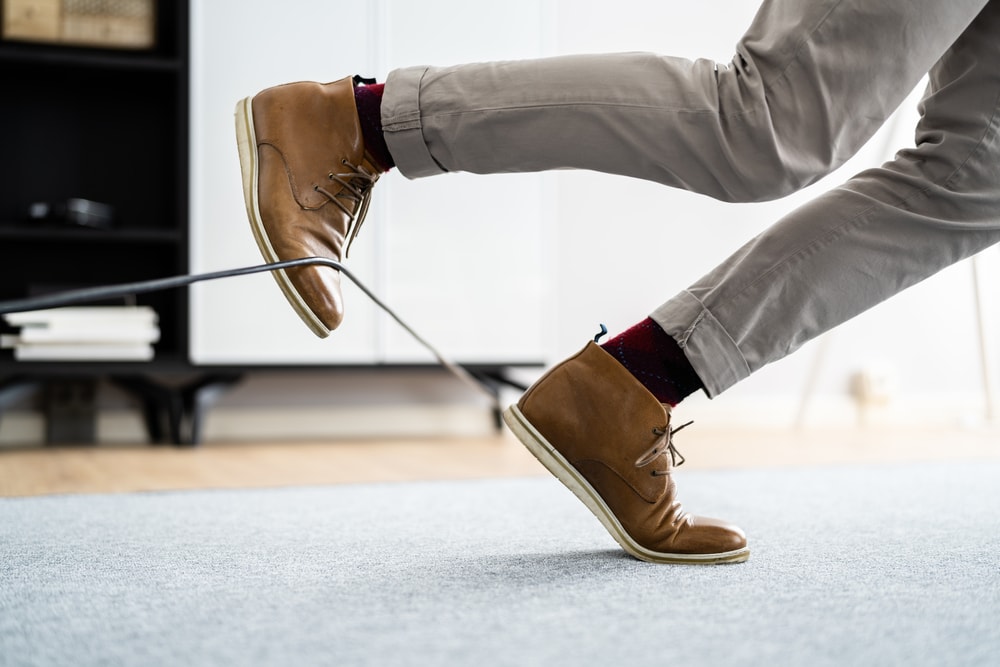
125,000 people are injured every year in a fall at home. Wet floors and tripping hazards such as shoes lying around, loose cables or wobbly stools are often the "culprits".
Editorial - 21 March 2023
Image: depositphotos
Falls are by far the most common cause of accidents in Switzerland. More than 40 percent of them happen at home. Every year, 125,000 people are injured here when they fall. These falls have serious consequences, and not just for older adults.
Of the total of 14,500 people who are seriously injured each year when they fall, 7200 are of working age, i.e. between 17 and 64 years old. Some of these accidents end in disability. The bottom line is that working people account for about half of the costs associated with home and recreational accidents. Due to falls alone, the annual material costs in this age group amount to 1.4 millliarden francs.
Risk of falling can be greatly reduced
More than half of all falls among people between the ages of 17 and 64 happen on the same level. One fifth of all fall accidents occur on stairs and steps, and around one in four falls from a height. Although the latter occur less frequently, they often have more serious consequences. It is therefore worthwhile to get the sturdy stepladder or folding step out of the basement instead of climbing onto the stool standing around. In general, the risk of falling can be greatly reduced with simple measures. For example, the BFU advises that wet floors should always be dried immediately and that objects lying around that could become a tripping hazard should be removed.
National "wanted" notice
Such "offenders" who cause falls, the BFU now writes with a wink in a national campaign for the "Major manhunt" off. She looks for tripping hazards such as sneakers lying around, loose cables, stuffed animals or wobbly stools. In doing so, she points out that it's dangerous to leave something "short" on the stairs just because it's convenient and comfortable. All info on the subject of falls as well as a practical Checklist for a safe home the BFU has published in a Dossier on bfu.ch compiled.
Source: AAIB
Two-thirds worry about their web accounts
According to a study by the German industry association Bitkom, many users are currently afraid of identity theft, hacking and online fraud.
Florian Fügemann, pte - March 20, 2023
Image: depositphotos
Two-thirds of Internet users in Germany are afraid of illegal use of their passwords and online accounts. 46 percent are also worried about online banking fraud and 34 percent about online shopping fraud, according to a survey of 1014 Internet users aged 16 and over conducted by the German digital association Bitkom.
Free ride for espionage
According to their own statements, almost two-thirds would not notice if strangers spied on their computer or smartphone via the Internet. "Consumers must be able to move safely in the digital world," says Susanne Dehmel from the Bitkom management board on the occasion of "World Consumer Day" in mid-March.
Only 41 percent believe that they are able to adequately protect devices such as computers and cell phones from attacks by cyber thugs. The figure is 46 percent among 16 to 29-year-olds and 47 percent among 30 to 49-year-olds. By contrast, the figure is 40 percent for 50 to 64-year-olds and only 31 percent for older people aged 65 and over.
Frequent and prolonged work at a computer screen can lead to neck and headaches, burning eyes or pain in the shoulders, arms and hands. This does not have to be the case.
Regula Müller, Suva - March 20, 2023
Image: depositphotos
Poorly designed workplaces can cause physical discomfort. This problem can be found in all industries and in all kinds of workplaces, whether at machines, on the assembly line, behind the counter, in assembly or in the office at the computer screen. The longer one works at a computer screen, the higher the risk of complaints. Eye burning, neck pain, headaches or pain in the shoulders, arms and hands are the most common complaints mentioned by the people affected.
Neck and shoulder pain
With neck tension, the screen is often set too high or positioned too sideways. Even jamming the telephone receiver between the ears and shoulders is not conducive. Shoulder discomfort is also often due to tables and chairs set too high or too low. This causes the shoulders to be pulled up when working. Having the mouse and keyboard too far away from the body leads to an unhealthy extension arm posture, which can cause strain. Elbow and wrist discomfort may be due to a mouse that is too large. This should fit the size of the hand. In addition, a mouse speed that is set too slowly can lead to wrist movements that trigger complaints. The mouse speed should therefore be set to "fast".
Back and eye complaints
Back complaints are often due to the fact that documents to be processed are placed directly in front of the upper body or next to the keyboard. This leads to a bent back. Armrests are also triggers for back complaints: If you lean on an armrest while sitting, this leads to a crooked posture. Eye complaints occur when working at a computer screen for too long at a stretch and when the lighting is also unfavorable. Regularly looking into the distance relieves the eye. To moisten the eyes, conscious closing of the eyelids helps. Standard progressive spectacles should not be worn when working at a computer screen. They restrict the field of vision too much. Since the area of progressive lenses for reading tends to be at the bottom, a natural head posture is hardly possible. This leads to neck problems. Glasses specially designed for VDU work are therefore the better solution.
Ergonomics and well-being
Physical complaints affect the performance of the employees concerned and cause lost working hours. All of this puts a strain on the income statement of the individual companies. Ergonomic workplaces have a great influence on the well-being of employees. The importance of ergonomic workstation design increases with the duration of use. The longer the time spent working at a computer screen, the more attention must be paid to getting the details right. The correct positioning of table, chair, screen and keyboard takes only a few minutes, but has a great effect.
Quality and productivity
If the work design meets people's needs, the physical strain is less and employees tire less quickly. In addition, motivation increases. Both have a positive effect on quality and performance as well as on productivity. In addition to ergonomic furnishings, posture, movement and interruptions to work also prevent complaints. In the best case scenario, sitting, standing and walking activities alternate. Ideally, the workload should be divided as follows: 60 percent sitting, 30 percent standing and 10 percent walking.
Costs and amortization
If ergonomics is already taken into account during the planning and new installation of workplaces, there are usually no or only very modest additional costs. However, if existing work equipment and workplaces have to be upgraded due to ergonomic deficiencies, this usually involves costs. But even in this case, the necessary investments are usually quickly amortized. This is because the ergonomic design of work usually brings considerable savings through the aforementioned reduction in the number of illnesses and accidents as well as performance increases thanks to healthier and more motivated employees.
Source: Suva
Sugar reduction in food
In mid-February, President Alain Berset signed an extension to the so-called "Milan Declaration". Since then, a total of 24 Swiss companies have committed themselves to the path of voluntary sugar reduction in food.
Editorial - March 14, 2023
Image: depositphotos
According to the Federal Office for Food Safety Swiss people still consume twice as much sugar as the World Health Organization (WHO) recommends. We are talking about around 100 grams or 25 sugar cubes per day. But too much sugar clearly makes people ill. Later indicators and consequences are obesity, cardiovascular disorders or even type 2 diabetes. So far, 14 food manufacturers and retailers have already signed up to the so-called Milan Declaration, which Federal Councillor Alain Berset first launched at the World Expo in Milan in 2015 for voluntary sugar reduction. With the inclusion of the new food groups soft drinks, mixed milk drinks and quark, ten more companies have now joined the "Milan Declaration". joined.
No agreement on salt reduction
The joint declaration so far includes a commitment to gradually reduce the sugar content in yogurts and breakfast cereals in particular by the end of 2024. The signatory companies want to reduce the sugar content of other products by ten percent by the end of 2024. Surveys by the Federal Food Safety Office (FSVO) showed that 38 percent of the added sugar in our diet comes from beverages.
There is still no agreement on salt reduction. Salt consumption is also well above the recommended daily intake according to the WHO recommendation (at over five grams per day). The FSVO has so far proposed initial salt reduction targets for soups and salad dressings to the food industry.
These companies have signed the Milan Declaration:
New (since February 14, 2023): Mineralquellen Adelboden AG, Coca-Cola Schweiz GmbH, Goba AG, Mineralquelle Eptingen AG, Ramseier Suisse AG, Mineralquelle Rhäzüns, Rivella Group, Trivarga AG, Vivi Kola AG, Volg Konsumwaren AG
Previously: Aldi Suisse AG, bio-familia AG, Bossy Céréales SA, Coop Genossenschaft, Cremo SA, Danone Schweiz AG, Emmi Schweiz AG, Kellogg (Schweiz) GmbH, Lidl Schweiz AG, Migros-Genossenschafts-Bund, Molkerei Lanz AG, Nestlé Suisse S.A., Schweizerische Schälmühle E. Zwicky AG, Wander AG
Cybersecurity executives could change jobs more by 2025
According to a study by Gartner, nearly half of all cybersecurity executives may change positions by 2025. A quarter of them may even move into a completely new role due to multiple workloads.
Editorial - March 14, 2023
Image: depositphotos
A Study from Gartner concludes that cybersecurity executives are currently under tremendous stress levels. The "defensive posture" of being affected by a major IT security incident at any time has a psychological impact, which in turn is likely to affect decisions and performance within the team of a cybersecurity organization.
Humans are the main cause of security incidents
The analysis by the U.S. ICT market research firm also concludes that the dynamic and enormous market opportunity for cybersecurity professionals poses another threat to security teams, as increased potential decision-makers from this field are likely to change positions. Compliance-driven cybersecurity programs, little executive support and insufficient maturity in the field are all indicators of an organization that sees vulnerability management as critical to business success, Gartner writes.
According to Gartner, companies of this type are likely to increasingly migrate to other areas. The higher turnover will be noticeable, it said, because the influence of security executives in ICT is generally valued. According to Gartner, cybersecurity executives are expected to change jobs by 2025. Twenty-five percent will even anticipate a completely different role within that timeframe.
Burnout and voluntary turnover, meanwhile, are the consequences of a poor corporate culture. Eliminating stress always remains an unrealistic goal, Deepti Gopal, director analyst at Gartner, is quoted as saying in the report. However, in cultures where employees are supported, people are able to handle incredibly demanding and stressful tasks, Gopal said.
Limiting factors
Investigation reports repeatedly mention "human error" as the cause of accidents. Despite sophisticated technology, the human factor seems neither controllable nor predictable.
Dr. Cornelia Nussle Achermann, Psychologist, psycon GmbH - November 10, 2022
All experience indicates that accidents cannot be avoided even with a high level of technical effort and intelligent control. Non-observance of technical specifications, age, current personal problems or biological fluctuations are cited as causes of human error. The question should be formulated in terms of how risk-affine persons can be differentiated from safety-oriented, attentive persons for sensitive activities.
Human error
People in responsible jobs are expected to have conscious control over their actions. What decides whether a mistake or a wrong decision suddenly happens at moment X? Everyday life is not uniform. On the one hand, people are subject to biological fluctuations and psychological stress. On the other hand, situations can reach a higher degree of complexity than usual and require extraordinary decisions. Acting in complex situations requires a high level of mental alertness, creativity and self-confidence.
Personal causes for misjudgments and wrong decisions
Most accidents resulting from human error are based on misjudgments and correspondingly wrong decisions. The list of causes is longer:
Learned carelessness (Frey & Schultz-Hardt, 1997): The term speaks for itself. It is about people who, floating on a cloud of constant experience of success, can neither recognize their failures nor the consequences of their actions. Carelessness is celebrated and care is unnecessary effort. Those who live in a state of carelessness are slow to change this state of being, even when information about a potential danger is available.
Information losses or information deficitsOn the way from A to B, serious losses of information often occur. The decision which information is relevant for B is subject to subjective filters of the person A who has the information. This can be based on an incorrect assessment of the context and consequences of content.
Missing parameters: Information deficits also arise when a person with a more pragmatic, hands-on nature relieves himself of tiresome information research. Others, however, look for information first before they act.
Carelessness: People in an alert mental state react more attentively and quickly to changes and unexpected situations. Mental alertness is considered the most important prerequisite for reacting optimally in complex situations. Mindfulness or alertness can be negatively influenced by personal problems.
Physiological factors
These include needs such as rest, hunger and thirst. Fatigue reduces attention and thus the quick and clear reaction speed. The negative effects of thirst and hunger can be easily observed in children. They become grumpy and react diffusely. The brain is our high performance organ. It consumes the most energy, especially when it is challenged. With the factor age the wealth of experience is positively connected, since problem definitions were already once through-exercised. However, age also brings with it a reduced thinking capacity that cannot be calculated in advance.
Some of the causes of misperceptions are intrinsic to the person, while others are situational. The factors intrinsic to the individual can be identified in good time during recruitment.
Capture personal characteristics
In which areas can predictions now be made in the context of recruitment? There is a new instrument for this: the Zug Stress & Personality Profile (ZSPP®). Captures mental presence (alertness) as an important prerequisite for an accurate, adequate response. However, such reactions can be slowed down by internal stressors. The ZSPP® is the first instrument to measure these blockages. Furthermore, the handling of information, reliability, independence, self-efficacy, solution orientation and social aspects such as cooperation in a team are measured.
Federal government paints bleak picture of security situation
According to the Federal Intelligence Service, the increased competition among major and regional powers is also leading to intensified prohibited intelligence activities globally.
Editorial - November 10, 2022
Image: depositphotos
At its meeting on November 9, 2022, the Federal Council approved the annual report on Threat Assessment (NDA) was adopted. Overall, Switzerland's security environment remains "volatile. The detailed report concludes that early detection and anticipation must be further developed.
As already stated in the supplementary report to the Security Policy Report 2021 emergedthe war in Ukraine had further-reaching effects. In particular, international security and defense cooperation in Europe has intensified. The terror threat in Switzerland remains elevated: Attacks by lone perpetrators or small groups with little logistical and organizational effort continue to represent the "most likely terror threat," according to the intelligence service.
Increase in prohibited intelligence activities
The conflict between East and West also led to a worldwide intensification of prohibited intelligence activities. With regard to the threat to critical infrastructures, the report further sums up that digitalization has experienced a further boost due to the measures taken to combat the Covid 19 pandemic, which has now come at the expense of security.
Threats to critical infrastructures therefore did not only emanate from cyber criminals...: Physical attacks are also possible at any time, as a conventional war between industrialized nations is a threat to numerous critical infrastructures and could have a direct impact on Switzerland, as the case of the Zaporizhzhya nuclear power plant has shown. In the report, the Federal Council emphasizes in particular the need to further develop competencies for security policy early detection and anticipation and to perform this task even more comprehensively and systematically in cooperation with various federal agencies.