From April 27, 2020, the first facilities such as medical practices, hairdressing, massage and beauty salons will be able to resume operations. Later, sports facilities, school buildings and other institutions will follow. In most cases, their drinking water installations have hardly been used for several weeks, which promotes the formation of microorganisms such as Legionella, which can cause severe pneumonia (Legionnaires' disease). For this reason, it is imperative that drinking water installations are flushed before they are put into operation.
The measures adopted by the Federal Council in connection with the outbreak of coronavirus will be from 27 April 2020 gradually loosened again.
Drinking water installations of publicly accessible buildings and facilities must be thoroughly flushed before this date, or before commissioning. This means that all water points where water is tapped must be opened and flushed. This includes, for example, water taps, shower heads, water connections, etc.
It is important to open several tapping points at the same time. This ensures a sufficiently strong flow in the pipes. The process should run at least until the temperature of the flowing water remains constant. Flushing must be done separately for the cold and hot water. This simple and effective measure serves to protect the health of the users. The Swiss Gas and Water Association (SVGW) has published a Specialized information created.
People aged 65 and over have an increased risk of a severe course of Covid-19 and should currently stay at home. However, those who do not exercise enough lose muscle mass; this increases the risk of falling. Each year, more than 85,000 seniors are injured in falls. There is a lot you can do to prevent falling accidents in your own home: The BFU and its partners provide tips on how to stay active at home at sichergehen.ch.
Every year, more than 85,000 older people aged 65 and over fall so badly that they require treatment by a doctor or in a hospital. The causes are manifold: physical factors such as lack of strength and balance or visual impairments play a role. But external aspects such as slippery floors, lack of handrails and railings, or poor lighting also lead to falls. Because people over 65 belong to the Covid 19 risk groups and are currently expected to stay at home, their risk of falling increases - if they do not exercise sufficiently.
A rolling stone gathers no moss
Those who do not move quickly lose Muscle masswhich tends to diminish in old age anyway. The sense of balance also decreases with age. The risk of falling increases. Most of the time, such accidents happen in everyday situations: when climbing stairs, going for a walk or cleaning the house. However, the risk of falling can be counteracted with physical and mental training. This has been proven by numerous studies. With sichergehen.ch, the BFU and its partners (including Pro Senectute and Health Promotion Switzerland) operate a platform where you can also find exercises for training at home - at different levels.
Adjust level slowly
Especially older people who already have a restriction (and therefore e.g. a rollator) or are weakened should definitely train in order not to lose even more mobility. However, it is very important to start with light exercises, increase them slowly and become more stable along the way. For example, to strengthen your muscles, you can hold on to a chair or the kitchen combination, lightly bend into the Knee walk and stand up again. For people without restrictions, it is recommended to start with the standard program on sichergehen.ch. A Exercise example for balance training is to stand on one leg and tap the floor sideways with the other. The well-trained can perform the exercises on unstable surfaces.
More info
www.bfu.ch
The ticks are loose again
Despite Corona crisis, walks in the forest and across meadows are allowed. Work also continues in forestry and horticulture. Forests, meadows and gardens are mostly tick areas in Switzerland. Watch out: The small animals are now active again!
Although one hundred percent protection against tick-borne diseases is not possible, the risk of a tick bite can be reduced with simple behaviors:
In the forest, in gardens and along roadsides, avoid brush and undergrowth to avoid shedding ticks.
Wear closed clothing of a light color (this allows ticks to be detected and removed before they get on the skin).
Use tick repellent for skin and clothing.
After stay in the forest or garden body after Ticks scan
If a tick is found: Remove as soon as possible (best with pointed tweezers or special tick forceps).
Suva's occupational physician, Felix Ineichen, recommends that all people who regularly spend time outdoors, and especially those who work in forests and meadows, take a Tick vaccination. "The tick vaccination protects against tick-borne encephalitis. This can be triggered by a virus that infected ticks can transmit to humans when they bite," says Suva's tick specialist. For occupational groups with an increased risk of tick bites, the employer pays for the vaccination.
Suva and the other UVG insurers record a good 11,000 tick bites each year. Tick bites are considered accidents under insurance law. Overall, they cause annual costs of around 12.4 million Swiss francs. 90 percent of tick accidents occur during leisure time. Tick accidents during work are rather rare. However, certain occupational groups, such as foresters, have a greatly increased risk of tick bites.
At its meeting on 16 April 2020, the Federal Council adopted adaptations and clarifications to Ordinance 2 on measures to combat coronavirus (COVID-19). These adjustments and clarifications are intended to prevent ambiguities and misunderstandings and provide clarification for the population. In particular, the ban on shopping tours and the fine regime are explicitly regulated.
Since mid-March, Switzerland has reintroduced temporary internal border controls and imposed entry bans for health reasons. The restriction of travel serves to protect the health of the resident population in Switzerland and is intended to prevent further spread of the coronavirus. These measures have been established over the last days and weeks. Current information shows that the implementation at the external borders and at the airports is working well for the most part. The Federal Council discourages non-essential travel.
However, the Federal Customs Administration (FCA) has continued to see brisk cross-border shopping behavior in recent weeks. These controls tie up FCA resources that would be needed for effective internal border control. To clarify the current practice, the COVID-19 Regulation 2 supplemented with an article. On re-entry into Switzerland, a fine of 100 francs is imposed if there is obviously a case of shopping tourism and the border was crossed exclusively for this purpose. This fine does not sanction the purchase per se, but the obstruction of the work of the border control authority.
Removing or damaging border barriers or signaling etc. is still subject to a fine, as is taking over goods at border crossings that are not open. Article 4 of the Ordinance has been clarified accordingly. Persons whose entry is not permitted according to COVID-19 Regulation 2 will be refused entry, but they will not be fined. An appeal against a refusal of entry can be lodged with the State Secretariat for Migration (SEM). Swiss citizens and persons with a residence permit in Switzerland are entitled to enter Switzerland at any time, regardless of the purpose of the border crossing.
As of April 27, 2020, hospitals may once again perform all procedures, including non-emergency ones, and outpatient medical practices as well as hairdressing, massage and beauty salons may resume their operations. DIY stores, garden centers, flower stores and nurseries will be allowed to reopen.
The protection of the public and employees must be taken into account in this Loosening of measures must be ensured. This was decided by the Federal Council at its meeting on April 16. If the situation allows, compulsory schools and stores are to reopen on May 11. Then, on June 8, secondary, vocational and higher education institutions, as well as museums, zoos and libraries are to reopen. The Federal Council has also specified the protection of particularly vulnerable employees.
Due to the epidemic development and based on recommendations from the scientific community, the Federal Council is relaxing the measures to protect the population from the new coronavirus as of April 27. In order to create planning certainty, it also announces how it plans the further relaxation steps until the beginning of June.
For the order of the relaxations, the Federal Council took several risk factors into account. These include the increase in close personal contacts, the increase in flows of persons, the number of vulnerable persons affected or the possibility of taking protective measures. In addition, the Federal Council assessed the economic benefits of the individual relaxations.
Protection of health and reduction of economic damage The Federal Council is pursuing several objectives with the relaxation strategy: It wants to continue to protect the health of the Swiss population as its first priority, especially the Particularly vulnerable persons. The relaxations are accompanied by protection concepts. Depending on the industry, these may include a recommendation or obligation to wear masks. The Federal Council also wants to keep economic damage to a minimum and reduce restrictions on fundamental rights where possible. The strategy is to be implemented uniformly throughout Switzerland, taking into account the measures of neighboring countries.
First stage on April 27, 2020 In the first stage, the Federal Council will relax the measures from April 27 for facilities that have only a small number of direct contacts, can easily implement protection concepts and do not cause significant flows of people. Measures in the inpatient medical sector will be relaxed, and hospitals will once again be allowed to perform all procedures. Similarly, outpatient medical practices can resume normal operations and perform all procedures, including non-urgent ones. These include dental, physiotherapy and medical massage practices. This is also intended to prevent negative consequences that could result from not providing treatments and examinations.
Businesses offering personal services with physical contact can also reopen, for example hairdressing salons, massage practices, tattoo studios and beauty salons. Home improvement and gardening stores, as well as nurseries and flower stores, will also be able to reopen. In addition, unattended public facilities such as car washes will also be able to reopen. Finally, the restriction to close family members at funerals will be lifted.
In addition, as of April 27, the assortment restrictions in grocery stores will be lifted. If everyday goods and other goods are on the sales floor of grocery stores, they may be sold.
Second and third stage: May 11 and June 8, 2020 In the second stage, compulsory schools as well as stores and markets are to reopen from May 11. The Federal Council will make its decision on April 29. In a third stage on June 8, secondary schools, vocational colleges and universities are to be allowed to hold face-to-face events again. At the same time, entertainment and leisure facilities such as museums, libraries, botanical gardens and zoos are to reopen and the ban on public gatherings is to be relaxed. The Federal Council plans to decide on the details of this stage on May 27. The Federal Council has not yet taken any decisions on further stages. It will decide at one of its next meetings when major events will be possible again.
Stages depending on the development of the epidemic The transition from one stage to the next occurs when there has been no significant increase in COVID-19 cases. Sufficient time must elapse between the individual steps to be able to observe the effects of the relaxations. Criteria are the number of new infections, hospital admissions and deaths, and hospital occupancy rates.
As soon as the number of cases in Switzerland has fallen sufficiently, the cantons will resume consistent tracing of infection chains: infected persons are to be detected, treated and isolated at an early stage, the transmission chains elicited and further transmissions prevented. To this end, an expanded testing strategy, a contact tracing concept, and an app that provides information about contacts with infected persons are being developed. The measures for keeping distance and hygiene remain valid and important. Particularly vulnerable persons should continue to stay at home.
Protection of employees at particular risk With the gradual opening of certain services and companies, particularly vulnerable employees are to be comprehensively protected. The Federal Council has therefore specified the definition of particularly vulnerable persons and the protective measures.
The employer has a duty to protect persons at particular risk from work from home if necessary, by providing appropriate substitute work. If the presence on site is indispensable, the employer must protect the person concerned by adapting the procedures or the workplace accordingly. A person at particular risk may refuse to work if he or she considers the health risks to be too high. If it is not possible to perform work at home or on site, the employer must release the person with continued pay. The employer may request a medical certificate showing why an employed person belongs to a particularly vulnerable group of persons.
Due to the epidemiological situation, the Federal Council has authorized the canton of Ticino to extend the restrictions on economic sectors until April 26.
New head of the FOPH's Communicable Diseases Division
Stefan Kuster took over as head of the FOPH's Communicable Diseases Division on April 1, 2020, succeeding Daniel Koch. The latter will retire, but will continue to work as "FOPH delegate for COVID-19" during the coronavirus pandemic. He advises and supports the FOPH on the coronavirus pandemic and represents it in public.
On April 30, 2020, Daniel Koch will retire after 12 years at the helm of the FOPH's Communicable Diseases Division. Due to the extraordinary situation, he will remain with the federal government: For the duration of the coronavirus pandemic, Daniel Koch will continue his previous tasks in the fight against this virus as "FOPH delegate for COVID-19". In this role, he advises and supports Pascal Strupler, the director of the FOPH, as well as the office's task force on the Coronavirus pandemic. Daniel Koch will continue to represent the FOPH at federal media conferences.
Stefan Kuster succeeded Daniel Koch as Head of the Communicable Diseases Division on April 1, 2020. Stefan Kuster holds a medical degree with postdoctoral qualification and a dual specialty in General Internal Medicine and Infectious Diseases. He obtained a Master's degree in Clinical Epidemiology and Healthcare Research from the University of Toronto, which he complemented with an Executive MBA. Stefan Kuster has held various positions at the University Hospital Zurich and at the national center for infection prevention Swissnoso. Most recently, he worked as Head Physician at the Clinic for Infectious Diseases and Hospital Hygiene at the University Hospital Zurich. Stefan Kuster lives in the canton of Zurich, is married and has two children.
Worldwide, the Corona pandemic is having a massive impact on all planned events in the coming months. The organizers of the trade fairs ArbeitsSicherheit Schweiz and Swiss Corporate Fashion are postponing the attendance dates to the period from November 10 to 12, 2020. To bridge the period constructively, the project team is offering an online conference at short notice. This virtual partial edition of the two events will take place from June 23 to 25.
At present, it cannot be assumed that events in May 2020 will be approved by the authorities, as the Corona Pandemic is obviously keeping world events in suspense for some time to come. The organizer of the trade fairs ArbeitsSicherheit Schweiz and Swiss Corporate Fashion, boerding exposition SA, decided to postpone the event after intensive consultations with the relevant authorities and cooperation partners.
In addition to the new appointment, he offers additional online formats, so boerding ensures the exchange of the occupational safety industry and corporate fashion managers and provides valuable input.
Trade shows to be rescheduled for November 10-12, 2020 ''Due to the biennial rotation of the both trade fairs the entire project team has already been working on the preparations with full force and enthusiasm since spring 2018. We are in very close coordination with our partners and exhibitors and keep coming to the same conclusion: the trade fairs will take place - as soon as circumstances allow,'' summarizes project manager Kirsten Maul from organizer boerding exposition SA. The new date has been set for November 10-12, 2020, as close to the end of the year as possible to prevent any further postponement.
The long-standing good cooperation with the responsible persons of the venue Bern Expo can also be continued for the alternative date. All bookings and tickets will thus remain valid. Kirsten Maul reveals: ''We will make good use of the time to the new date to promote the topic of industrial hygiene together with our partners and exhibitors. This topic will accompany the entire industry in the future, so this step is a logical consequence to upgrade our trade shows. ''
Dates set for new "Online Conferences" event format To bridge the gap until the attendance date, online conferences will be held for the first time from June 23 to 25. The organizer boerding has had great success with this virtual format in the recent past. In 30-minute webinars each, experts in occupational safety and the topic of Corporate Clothing their know-how, after which they will answer questions from attendees on their specialist topic. ''We promise all partners, speakers, exhibitors and visitors a clear communication of the next steps. We are further motivated and sure that the importance of our exhibition topics will play an even greater role in the future. We are prepared for it.'' says project manager Maul.
Electronic patient dossier: certification requires more time
The first electronic patient dossier (EPD) will not be offered until the summer and not already in the spring. The reason is the certification of the parent communities, the future providers of the EPD, which is taking more time than planned. By the scheduled launch date of April 15, 2020, at least one of the eight tribal communities should have completed certification and be able to begin operations in the summer. The other trunk communities will follow by the fall.
A large number of players are currently working on the introduction of the electronic patient dossier (EPD). In addition to the decentralized parent communities that will offer the EPD, these include the developers of the technical platforms, the certification bodies, the accreditation body and the providers of electronic identification means.
The establishment of the parent communities and the technical platforms has worked well. However, the certification of the root communities and the subsequent accreditation of the certification bodies are taking longer than originally planned. The certification ensures that the protection of the Patients is ensured and the parent communities meet the strict requirements of the EPD Act. As a result Acute Care Hospitalsrehabilitation clinics and inpatient psychiatric clinics can join a certified parent community.
Program Committee takes note of delay
The federal and cantonal program committee on the EPD has noted that there are delays in this complex project with its decentralized structure. It recognizes that the scope of the certification process could not be accurately estimated at the time of the legislation. However, the Program Committee expects that all residents of Switzerland will be able to open an EPD by the fall of 2020. It is also clarifying whether the parent communities can make the best use of the time until final certification with a test phase. For healthcare in Switzerland, an EPD connection of the hospitals delayed by a few weeks to months will not have any negative consequences.
TCS makes its Carvelo2go fleet available free of charge to organizations, companies or private individuals who wish to provide voluntary support to people who are in need of protection due to COVID-19 and are in isolation or quarantine. In total, more than 300 Cargobikes of the TCS Mobility Academy are available in 70 Swiss cities.
While the measures of the BAG limit a distance of two meters between people and a gathering in public space to a maximum of five people, the population is looking for alternative ways to make purchases and get necessary medicines.
Carvelos at the service of volunteer work
For some weeks now, a moment of solidarity has developed in many places in Switzerland to support people at risk or infected with Corona. For example, volunteers go shopping for people belonging to a risk group. Such outreaches help to contain the spread of the virus and at the same time support vulnerable people to cope with daily life. TCS is now making its Carvelo2go fleet available free of charge for such missions.
Compliance with the hygiene regulations of the FOPH
To protect volunteers and their clients from a COVID-19-To protect against infection, Carvelo users are required to wash/disinfect their hands thoroughly before and after use, and to clean the steering wheel, gears, board computer, saddle, carrying bag and battery after each use.
It is obvious: The umbrella organization of the societies for safety and health at work, Suissepro for short, recently held its delegates' meeting as a conference call. Among other things, those present decided on the theme of the "Journée suissepro 2022" symposium.
Editorial - April 3, 2020
It also works like this - delegates' meeting as a telephone conference. Photo: R. Strässle
Even in times of pandemic, organizations and associations must continue to function as well as possible. The holding of a general or delegates' meeting (DM) is now part of the duty. Accordingly, the umbrella organization Suissepro held its annual DV on April 2 as a conference call. The agenda of the 31st Assembly of Delegates was completed relatively quickly this time: Both the DV minutes, the Suissepro annual report, the auditors' report and the annual accounts 2019 as well as the budget 2020 with determination of the central contributions were approved unanimously by the delegates; the actions of the Presidents' Conference were also ratified. The delegates also approved the annual report 2019 of the Limit Value Commission.
Limit value commission: replacement election not unanimous
This year, age-related resignations of the Suissepro Limit Value Commission are pending: Claudia Pletscher (Suva), Christian-Thomas Monn (Seco), Jean Parrat (occupational hygienist canton Jura) and Walter Spieler (Hoffmann-La Roche). The search for suitable candidates is currently underway and they will be put forward for election at the AGM in 2021.
The Limit Value Commission has proposed Patrick Steinle from Suva as the successor to Alois Gutzwiller, who left the commission in 2018. In its annual report, the commission writes that he has the expertise in workplace measurements that is needed in this case. This proposal was questioned at the DM by Fabia Schläppi, president of the Swiss Society for Occupational Hygiene (SGAH). She is of the opinion that the commission should be composed in a balanced way. In the end, the delegates elected Patrick Steinle with one vote against.
Suissepro president remains for another two years
The aim of Suissepro is to foster the interdisciplinary exchange of experience and knowledge between specialists in safety, occupational hygiene, ergonomics and health protection at the workplace. The umbrella organization is headed by Bruno Albrecht, who does not always have an easy task, as individual delegates noted; he deserves a wreath for his prudent leadership.
The president wanted to resign at this delegates' meeting. But the search for a suitable successor was unsuccessful. Bruno Albrecht therefore agreed to add another two years of office, which was unanimously welcomed by the delegates.
Secretary Ludwig Binkert, treasurer Christophe Iseli and the auditors Herbert Manser and Pierre-André Girardin were also confirmed without any dissenting votes.
Planned symposium - interdisciplinarity
The launch of a symposium requires a certain lead time. And so those present approved the conference "Journée suissepro 2022" with a deficit guarantee of 10,000 francs.
Fabia Schläppi, SGAH, suggested interdisciplinarity as the overarching theme for the planned symposium. A suggestion that met with great approval. According to one delegate, it was a topic that took full account of the umbrella organization's raison d'être.
Anyone who would like to be part of the organizing committee for the 2022 symposium can contact Bruno Albrecht (vorsitz@suissepro.org) or Ludwig Binkert (sekretariat@suissepro.org) report.
The next Suissepro Delegates Assembly will be held on March 25, 2021. (rs)
Occupational health and safety postponed for participation
NEW DATE: From November 10 to 12, 2020 (instead of May 26 to 28), everything will once again revolve around occupational health and safety in the workplace at Bernexpo for the 8th time. Around 200 exhibitors will be showing innovations from the fields of safety technology and protective equipment, among other things, embedded in an informative supporting program with specialist presentations and live shows. A special added value is offered by the hands-on safety course.
In addition to the presentation of innovative products and services for occupational health and safety in the workplace, the focus for trade visitors is on exchanges with experts and practical relevance. In numerous expert presentations and practical forums, they will receive first-hand, valuable impulses for everyday work, in which soft factors like psychosocial stress are thematized. Interactive learning opportunities and live demonstrations help to test one's own expert knowledge and to prepare for the Emergency to be optimally equipped. The ArbeitsSicherheit Schweiz trade fair, with its presentations and safety trail, is recognized and certified by the Swiss Society for Occupational Safety (SGAS) as a continuing education measure. Continuing education units are credited for participation in selected tours and events.
Test and implement your own knowledge
''A popular place to go this year will once again be the safety trail on offer,'' Kirsten Maul, project manager for the trade fair at organizer børding exposition SA, is certain. Already for the fourth time different exhibitors take over the sponsorship for individual stations of the safety course. At six posts distributed throughout the exhibition hall, visitors can interactively experience topics from their everyday working lives. As a special added value, there are also continuing education points for participation. ''The safety parcours builds a bridge into practice and offers the unique opportunity to test and implement one's own knowledge in concrete situations,'' says Maul.
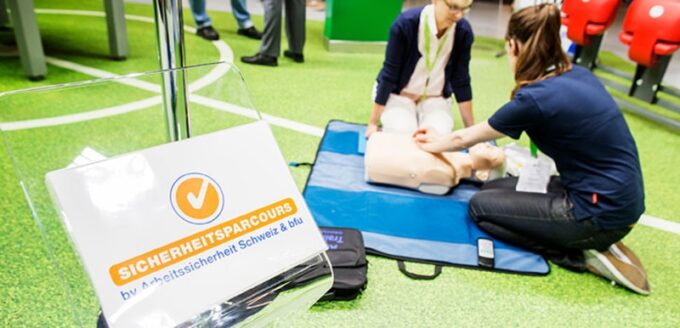
The station of the Swiss Association for Occupational Safety Switzerland is entirely in line with the motto of its annual theme "Join in". The aim is to make everyone involved in the company aware of Occupational safety to raise awareness. At the course station, the task is to solve puzzles in an escape room in order to rescue a group of people from an emergency situation. The program continues with balance exercises at the post of the Advisory Office for Accident Prevention (BFU), among other things, to raise awareness of fall risks. Knowledge tests on current regulations through to resuscitation exercises for first-aiders complement this station. The safety course is signposted with its own logo in the exhibition hall. The running cards for collecting points for recognition as a continuing education measure will be handed out at the trade fair office. The stations and exhibitors in detail:
Association Occupational Safety Switzerland: Participants solve puzzles in an ESCAPE room and free groups of people in a company.
bfu: Playfully to more balance: A BOSCO Balance Trainer shows effective exercises.
Delta Zofingen: Current revision EN 388: 2016 - What do I need to know? A short training on important areas.
Hymer light metal construction: Participants work through work instructions with test leaders according to the legal regulations in Switzerland. Checklists provide support.
Alpine Medic: The role of first responders - participants compete against each other and resuscitate injured persons - Dr. Bibber for advanced.
Schärer + Kunz AG: This station trains participants in the practical use of visual safety control systems using a small course.
Open Letter Prof. em. Sucharit Bhakdi on the Corona Crisis
Prof. Sucharit Bhakdi, MD, specialist in microbiology and infectious disease epidemiology, headed the Institute of Medical Microbiology and Hygiene at the University of Mainz for 22 years. He has written an open letter to the German Chancellor Angela Merkel with five questions that demand immediate answers to establish how justified the current massive restrictions on all our basic rights are.
Preface:Freedom of the press is a privilege and a duty
"The privilege applies to journalists and media companies. For both, it gives rise to obligations. Journalists are obliged to work fairly and carefully. The Swiss Press Council is the guarantor of this. And media companies are obliged to provide the economic conditions for independent, diverse journalism." (Excerpt from the "Manifesto for the Freedom of the Press" from the Swiss Association of Journalists impressum)
Information about the video of Prof. em. Dr. med. Sucharit Bhakdi
Comment by Markus Frutig, Editor-in-Chief of SAFETY-PLUS on 31.03.2020
Dear readers, customers, association partners and business associates.
Currently, due to the WHO proclamation of the pandemic level because of Corona/COVID-19 an unprecedented worldwide crisis situation with exit restrictions, - bans, prohibitions with partly draconian penalties (for example 5 years in prison in Italy in case of violation of the curfew for positively tested persons), which could result in millions of unemployed, individual insolvencies of self-employed persons and the bankruptcy of many SMEs. Switzerland and Germany will also be hit extremely hard by this emergency legislation, which will not only put all our readers, associations, customers and business partners at risk of financial losses in the millions, but also all our work or existence on a massive scale.
Interestingly, Sweden or many Asian countries such as Japan, Singapore, Hong Kong or Taiwan make it quite easy by all citizens respirators distribute to eliminate the risk of droplet infection before things get worse. Shouldn't our health boards learn from this as well? Quote in n-tv article "Their prescription: masks for everyone, tight controlling and digital tracking of the sick. Keep your distance (especially with the elderly) and pay attention to hygiene anyway."
Because the world-wide, financial consequences with the indebtedness over the billion-heavy emergency credits become already now with each day, each week of the standstill incalculable and can roll up to an avalanche, which could cost still more insolvencies and human lives, than the Corona crisis itself. Especially in the third world countries like in many states of Africa, India or Pakistan, where the people basically in poverty without any hygiene have a massively damaged immune system and do not survive curfews as "easily" as we currently do in Switzerland or Germany.
Therefore, it is not only for me as a Christian, Swiss citizen, journalist, engineer and trained health advisor morally, ethically and politically the duty to check also other facts and backgrounds to protect the basic civil, democratic rights of our freedom and to enable constructive discussions with the decision makers in politics and health care immediately and to adjust the measures appropriately before it is too late.
Prof. em. Dr. med. Sucharit Bhakdi the son of Thai diplomats, spent his childhood and youth in the USA, Switzerland, Egypt and Thailand. After studying human medicine in Germany, he embarked on a scientific career and most recently headed the Institute of Medical Microbiology and Hygiene at Johannes Gutenberg University Mainz for 22 years. He published over 300 articles in international journals and is one of the most cited medical researchers in Germany. During his multiple award-winning university teaching career, he brought the topic of infections to the attention of politicians and the public in countless appearances. In addition to numerous scientific prizes, he was awarded the Order of Merit of the State of Rhineland-Palatinate. (Source: Goldegg Verlag GmbH, Berlin)
Editor's book recommendation: "Specter of Infections -Myths, Delusions and Reality".
Review text: One in 10 deaths is due to infection ... Dangerous coli germs on airplane seats, Legionella in drinking water, multi-resistant bacteria, swine flu, Ebola - what is better suited for headlines? Isn't it ironic that we lose sight of the real risks in the process? In this book, experts of the first rank clarify: What role do the body's defenses play? When are vaccinations effective? What about "classic" childhood diseases? What helps with serious infections? When do antibiotics reach their limits? What are the dangers of multi-resistant bacteria? What about hospital-acquired infections? In an entertaining question-and-answer game, this book provides exciting insights into the nature of the most important infectious diseases. You'll be able to distinguish between sense and nonsense, know where real infectious dangers lurk, and how to counter them. Visit a fascinating and unknown world. The power of knowledge will help you to live a longer and healthier life - without prescription and without side effects. (Source: Goldegg Verlag GmbH, Berlin)