High employment rate among older workers in Switzerland
Compared with other OECD countries, Switzerland has one of the highest labor force participation rates among the over-55s. Nevertheless, in its recent report on the situation of older workers, the OECD concludes that an overall strategy is needed to improve age management in companies. The authorities should encourage the social partners to provide older employees with better offers and incentives to continue working into retirement age and beyond.
Editorial - February 8, 2015
In 2012, Switzerland's employment rate of 70.5 percent of 55- to 64-year-olds was nearly 17 percentage points above the OECD average (54%).
In 2012, Switzerland had an employment rate of 70.5 percent of 55- to 64-year-olds, almost 17 percentage points above the OECD average (54%). As in the other OECD countries, however, unemployed older people in Switzerland also find it significantly more difficult than younger people to get out of unemployment again. This is particularly the case for women and people with a low level of education.
The OECD recommends that Switzerland pursue an overall strategy and take further action in the following three areas: Strengthening incentives to work longer, removing barriers to the recruitment of older workers, and improving the employability of older workers.
The report can be obtained from the OECD be ordered.
Stumbling, dust, chips
On average, every 15th full-time employee in Switzerland suffers an accident at work every year. The new five-year report of the accident insurers provides a comprehensive overview of accident occurrence in Switzerland.
Editorial - January 21, 2015
Slipping and sliding is the most common cause of serious accidents at 46 %
More than one in four accident victims is hit by an object while at work; for example, because an employee accidentally hits the accident victim with a tool or drops something. This is also shown in the recently published five-year report of the accident statistics 2008-2012 from the collection point for the statistics of the accident insurance UVG (SSUV), which is located at Suva. In total, an average of 254,000 people were involved in accidents at work each year throughout Switzerland during this period; of these, 67,000 (26 %) were hit by an object. This makes it the most common cause of accidents.
With 65,000 persons, almost every fourth accident victim slips or falls. 24 % of these tripping accidents occur without an object involved, 20 % on stairs and in ten percent the victim is carrying a load. In eight percent, the weather plays a decisive role.
Accident victims cut or stab themselves third most often, mostly on the hand or arm. Almost half of these people cut themselves with a knife.
Although less than four percent of all occupational accidents are considered serious, they cause not only great human suffering but also two-thirds of the annual insurance benefits of just under CHF 1.4 billion. Slipping and falling is the most frequent cause of serious accidents, accounting for 46 %. The second most common cause of these accidents is falling - this happens mainly from ladders and scaffolding, and often the accident victims are carrying heavy loads. Falling accidents also frequently occur when workers are loading and unloading trucks with lifting platforms.
Every year, around 25,000 apprentices in Switzerland suffer an occupational accident, three of which are fatal on average. In other words, every eighth apprentice has an accident every year. To counteract this situation, Suva launched the "Safe apprenticeship" campaign at the beginning of 2013.
Editorial - January 16, 2015
Young people must be made aware of accident-free apprenticeships as early as possibleLearners have accidents much more frequently than their experienced colleagues at work
For one year she has been leading the Campaign in cooperation with partner organizations. Everyone agrees on one point: young people must be made aware of the need for an accident-free apprenticeship as early as possible. It is important to say stop when there is danger or uncertainty and to clarify the situation with experienced employees. Job-specific document folders, known as starter kits, contain everything that can be used to train and sensitize apprentices for a safe apprenticeship period. "In the training of apprentices, vocational trainers and supervisors play a key role in occupational safety. Suva's starter kits help them to fulfill this role," emphasizes Raphael Ammann, campaign manager at Suva.
The high accident figures can be explained by the fact that trainees are not yet able to assess the dangers in the workplace, do not yet have a systematic way of working, sometimes overestimate their own abilities or do not dare to ask questions if they are uncertain," says André Meier, head of the occupational safety department at Suva.
https://www.youtube.com/watch?v=1ziyF9xDBcI
New department head prevention offers
At its meeting on October 16, 2014, Suva's Administrative Committee elected 46-year-old Edith Müller Loretz as the new Head of the Prevention Services Department. She succeeds Beat Arnet, who left Suva at the end of January 2014.
Editorial - January 13, 2015
Edith Müller Loretz, new head of the prevention services department at Suva
With Müller Loretz, a person who is very familiar with Suva is taking over the management of the prevention offers department. A resident of Kriens and mother of two children, she joined Suva in 1998 as campaign manager for snowsports. She had previously studied business administration at the Lucerne University of Applied Sciences and Arts. In 2011, Müller Loretz was promoted to Head of the Leisure Safety Division and from then on was responsible for implementing prevention measures in the non-occupational accident business in companies and among the general public. Edith Müller Loretz took up the position of head of department, which comprises the areas of occupational health management, leisure safety and safety products, on November 1, 2014. She replaces Beat Arnet, who left Suva at the end of January this year.
The Prevention Services department employs around 40 people. It is committed to safe leisure time and safe and healthy work with campaigns, prevention modules and individual advice. In doing so, it focuses on sports and activities with high accident costs and high injury potential.
Jihadist-motivated travel movements - figures December 2014
The Federal Intelligence Service (FIS) is publishing for the third time the number of jihadist-motivated travelers from Switzerland who have been or are still in conflict zones. To date, 62 cases have been recorded, compared with 56 at the end of November 2014.
Editorial - December 15, 2014
From 2001 to the present, the FIS has recorded 62 travel movements that are considered jihadist-motivated.
Of the 62 jihadi travelers recorded from 2001 to the present, 37 went to Syria and Iraq and 25 to Afghanistan, Pakistan, Yemen or Somalia. Since these are cumulative figures, it must be emphasized that some of these individuals are still on the ground. Eight have died (five of them confirmed), others are traveling around the conflict areas or have returned to Switzerland.
Since the 56 cases recorded in November 2014, the FIS has registered eight new cases. Two other travel movements classified as unconfirmed have been removed from the list as they can be considered as not motivated by jihadism. While the increase in these figures compared to November points to an increase in the phenomenon, it also indicates that the more intensive cooperation between the cantonal police forces and the relevant federal authorities is making it possible to improve the detection of cases of potential jihadist travelers.
The number of returnees increased from 16 in November 2014 to 19 in December 2014; of these, three cases were confirmed. The classification of the 16 unconfirmed cases was based on the following criteria: Either the jihadist motivation of these individuals could not be proven and/or their exact whereabouts could not be determined with certainty. The FIS continues to investigate these unconfirmed cases.
The FIS does not disclose any further information on the identity, age, gender, nationality and residence of these persons. The FIS works closely and continuously with the authorities of the Confederation (Office of the Attorney General, Federal Offices of Justice, Migration and Police, Border Guard Corps, Federal Department of Foreign Affairs, etc.) and of the cantons (justice and police departments, cantonal police forces, etc.).
It is of high importance for the FIS to identify these persons and their motives with all available means. The new ND law, if approved, would provide the FIS with additional opportunities to do so. The motivations for young people to enter conflict zones are often very personal. Each case is different and prevention plays an important role here. However, it cannot be denied that calls for violence and jihad via Internet sites by persons apparently resident in Switzerland are assuming worrying proportions.
In May 2013, the FIS announced that there had been about 20 jihadist travelers from Switzerland to conflict zones since 2001. In May 2014, this number increased to 40 and in November 2014 to 56.
Never before have so many snow sports enthusiasts worn a helmet
The success story of the snow sports helmet continues: Last winter, 87 percent of all skiers and snowboarders on Swiss slopes wore a helmet - more than ever before. This is shown by the survey conducted by the bfu - Swiss Council for Accident Prevention. For the first time, the helmet-wearing rate was surveyed on sledding trails. Here it was shown that every second sledder protects his head with a helmet.
Editorial - December 9, 2014
Around one third of head injuries can be prevented by wearing a helmet
The bfu survey showed a wear rate of 87 percent in the 2012/2013 season - an impressive increase on the 16% of 2002/03. If we look exclusively at people living in Switzerland, the rate is as high as 90 %. Differences are still evident between the language regions: While 91% of snowsports enthusiasts wear a helmet on the slopes in German-speaking Switzerland, the figure in French-speaking Switzerland is significantly lower at 76%.
For the first time, the wearing rate of protective equipment on Swiss sledding trails was also surveyed. Half of the sledders and tobogganers wore a helmet. Children aged 7-12 were the most likely to wear a helmet, while adults aged 26-30 were the least likely. The survey also found that most athletes wore snow sports glasses or sunglasses while sledding. Braking aids on the shoes, on the other hand, were unfortunately hardly used, although soles with spikes, for example, would noticeably improve braking performance.
More than two million people living in Switzerland ski or snowboard. The downside of this pleasure is that every year around 65,000 of these snow sports enthusiasts have accidents (51,000 on skis and 14,000 on snowboards) and require medical treatment. In addition, there are almost 8,000 injured sledders and tobogganers. About 15 percent of the injured suffer head injuries. Around one third of head injuries can be prevented by wearing a helmet; it also helps to reduce the severity of the accident.
But it's not just the head that needs protection when skiing. Around half of those involved in accidents injure their knees, legs or feet. Correct adjustment of the ski binding can help prevent such injuries. The bfu is therefore launching its 23rd ski vignette campaign to motivate as many winter sports enthusiasts as possible to have their bindings checked at a sports retailer with the appropriate testing equipment. This is particularly important for children in the growth phase. The age, height and weight of the skier, the length of the sole and the skiing style - fast/aggressive or slow/restrained - are decisive for the correct setting. If the binding is correctly adjusted, the specialist sticks a bfu vignette on a ski as certification and prints out a receipt for the customer with the adjustment values, which they should keep. You can see which specialist stores are taking part in the ski vignette campaign in this overview.
The 13 young women and men of the Swiss delegation of the European Vocational Championships have worked and given everything during three days in Lille. With 1x European champion, 3x second place, 3x third place, 2x diploma and 2x certificate they have surpassed themselves.
Editorial - December 7, 2014
Happy about the strong performance: The Swiss delegation of the European Professional Championships
The Official Delegate Christine Davatz is proud of the very good effort of the Swiss team: "Our boys gave their best." But she also had to realize "that the requirements have increased and the competition is getting tougher and tougher".
Nevertheless: "The fact that every second person has won an award is simply great," she says, expressing her satisfaction with what has been achieved. "The Swiss team performed well under tough and difficult competition conditions," said Technical Delegate Rico Cioccarelli on the evening of the award ceremony, and also praised the experts in particular: "In Lille, the experts were asked to do a lot.
One of these experts is particularly proud of his protégé. Adrian Sommer, an expert in the field of electrical installation, admits that he has been torturing his candidate Severin Holderegger for the past six months. But it was obviously worth it, because the young man from St. Gallen won the European title for electricians by a clear margin. And that's not all, because on the evening of the award ceremony he wore two gold medals around his neck, the second for the title of Best of Nation for the Swiss team. He himself said: "It was amazing to receive the gold medal for the first time on stage. A second gold medal was then the icing on the cake."
EKAS: Carmen Spycher elected as new managing director
At its meeting on December 4, 2014, the Federal Coordination Commission for Occupational Safety FCOS elected 46-year-old Carmen Spycher as its new managing director. She will succeed Serge Pürro, who will retire next summer, on June 1, 2015.
Editorial - December 4, 2014
Carmen Spycher, from June 1 Managing Director of the EKAS
Carmen Spycher studied biology at the University of Bern and earned her doctorate at the Zoological Institute of the University of Fribourg. She later trained as a safety engineer and occupational hygienist. Since 2007, the biologist has been working as an occupational safety and health specialist at Suva's headquarters in Lucerne. Prior to that, Spycher worked as a scientific assistant at the Federal Office for the Environment and as managing director of the federal government's Biotechnology Contact Point, among other positions.
Farewell after 19 years
Carmen Spycher will take up her post as managing director of the FCOS on June 1, 2015. She succeeds Serge Pürro, who is retiring next summer. Pürro joined the EKAS in 1996 and has headed the office since 2006. During these 20 years, the world of work has changed rapidly - and with it the challenges to occupational safety and the prevention of occupational accidents and diseases. Serge Pürro worked with great commitment to ensure the coordination of prevention measures, the areas of responsibility in enforcement and the uniform application of regulations. The FCOS would like to thank him sincerely for this.
Not only at Christmas time: Online shoppers stumble over passwords
Just in time for the Christmas shopping season and the so-called "Black Friday", Kaspersky Lab, together with the French opinion research institute Opinion Way, analyzed the shopping behavior of Germans and Europeans in a study. According to the study, the majority (60 percent) of the German users surveyed want to buy most of their Christmas presents online. However, many have problems remembering the passwords for their accounts at online stores. Six out of ten Germans surveyed have already had to have their passwords reset.
Editorial - December 1, 2014
Many have trouble remembering passwords for their accounts at online stores
For Americans, Christmas shopping is associated with one date in particular: On the fourth Friday in November - i.e. today - "Black Friday," retailers outbid each other with discounts. It's a trend that has now reached Europe, too, especially on the Internet. Here, too, numerous online stores and mail-order companies organize discount days and weeks around Black Friday.
In fact, Christmas gifts are readily purchased online, especially in Germany, as the survey by Kaspersky Lab shows. As many as 60 percent want to cover the majority of their gift needs this way. Across Europe, online shopping is the trend among 52 percent of respondents.
Reset passwords
But with increasing use of the Internet, many find it difficult to remember the passwords for all the online stores they use. Only 39 percent of respondents from Germany said they had never been embarrassed by having to reset one of these passwords. 54 percent admit that this happens to them at least once a month, and for 8 percent it is even the case every day. And 7 percent have to have their password reset every time they visit an online store. This puts the Germans roughly in line with the European average. The main problem is the rules with which online stores want to force their customers to choose strong and therefore secure passwords. 48 percent of respondents from Germany (Europe: 47 percent) complain that these rules make it difficult to remember passwords. Nevertheless, a majority seems to recognize that this is a necessity, because only 28 percent in Germany (Europe: 34 percent) really feel that these rules are a nuisance.
Kaspersky Lab has therefore developed Kaspersky Total Security - Multi-Device, a holistic security solution for Windows PCs, Mac computers and mobile Android devices. It offers additional protection for online shopping with "Secure Payments" technology and stores and synchronizes all passwords. Users thus only need to remember a single master password to access all accounts. After all, not everyone uses the Internet in the same way. Informed users can quickly and easily determine which security solution is most suitable for their needs.
Semi-rugged computer technology
As the only semi-rugged device in its class, it is certified to MIL-STD-810G and IP5X and is used primarily by utilities, emergency services, the automotive industry, field service and military customers.
Editorial - November 28, 2014
S400-G3 notebook
The new S400-G3 notebook is available with the latest fourth-generation Intel® Core™ i3 and i5 processors for industry-leading performance - for example, in mapping applications or video processing.
Thus, on the one hand, the notebook offers protection against dust ingress, and on the other hand, it is designed to withstand the most adverse conditions such as drops, vibrations or high temperature fluctuations. Getac has developed a unique case structure that protects the device even when dropped during operation, making the S400-G3 one of the most durable semi-rugged laptops on the market.
Designed to ensure high performance in demanding environments, Getac's new notebook has been optimized to withstand even more extreme temperature ranges. This means users can use the notebook just as reliably in freezing -20°C as in hot 60°C temperatures. This makes it one of the most versatile semi-rugged devices currently available on the market.
Regin spies on GSM mobile networks
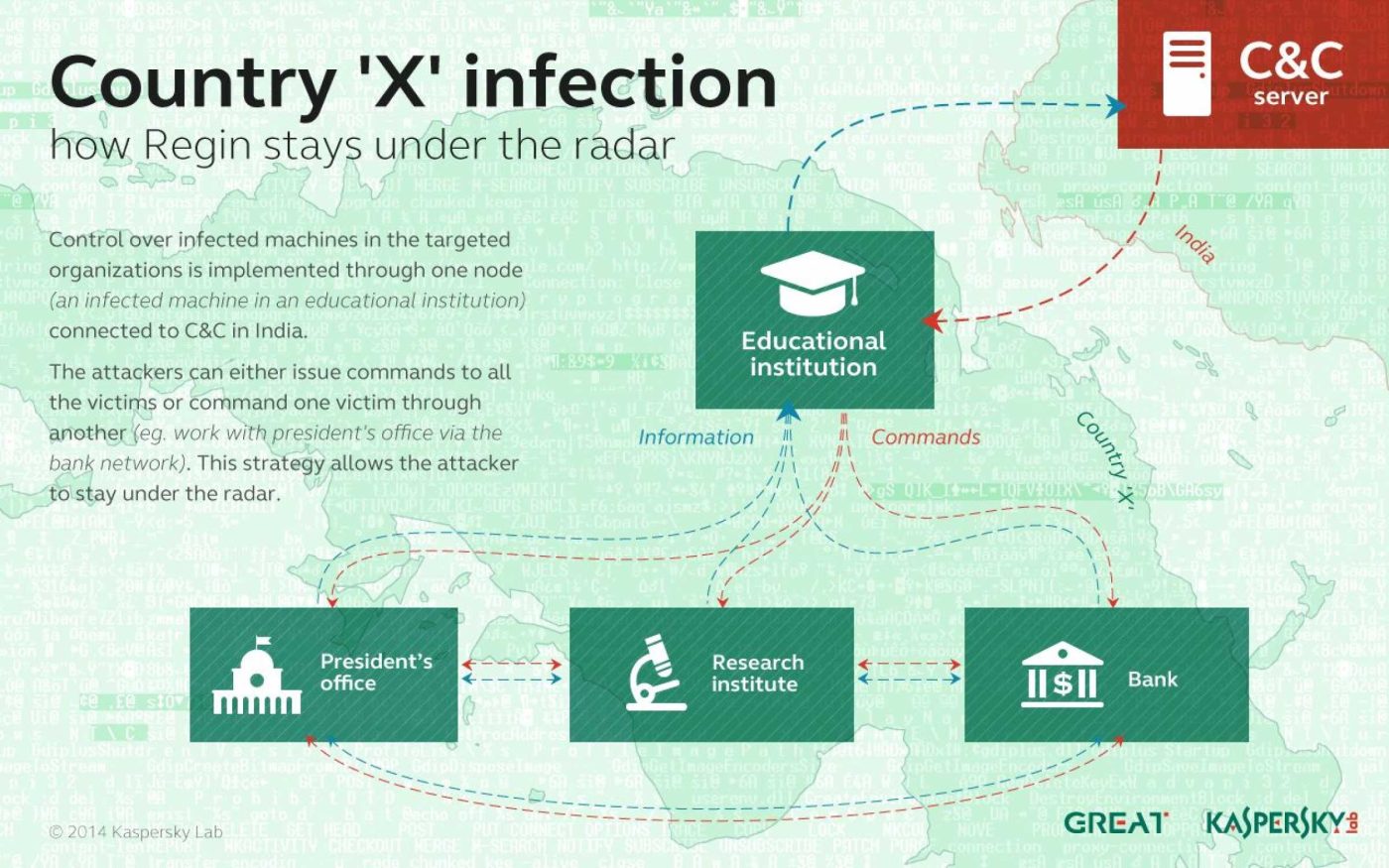
"Regin" not only engages in cyber espionage activities, but also infiltrates GSM digital telephony networks. Thus, millions of GSM users could be spied on. Regin's backers have so far infected computers in at least 14 countries worldwide.
Editorial - November 28, 2014
Millions of GSM users spied on with "Regin
Infographics for "Regin
Mobile networks attacked
The most interesting feature of the Regin platform is its ability to attack GSM networks. Kaspersky Lab was able to obtain the activities of a GSM base station controller during its investigation. According to the analysis, the attackers have obtained credentials that allow them to take control of GSM cells of a large mobile operator. Thus, they could have gained access to information about which calls were processed by certain GSM cells. In addition, the attackers could have redirected these calls to other cells or activated neighboring cells, as well as unleashed other malicious activities.
The attackers behind Regin are currently the only known group capable of carrying out such operations. The analysis of Kaspersky experts has produced the following findings, among others:
The focus of the attacks is against telecommunications companies, government institutions, financial institutions, research organizations, multinational political entities, and individuals whose field of research includes mathematics or cryptography.
Victims were identified in Afghanistan, Algeria, Belgium, Brazil, Germany, India, Indonesia, Iran, Kiribati, Malaysia, Pakistan, the Republic of Fiji, Russia, and Syria.
The Regin platform consists of various malicious tools that allow attackers to gain access to an organization's entire compromised network. A highly complex communication method between the infected networks and command-and-control (C&C) servers enables covert remote control and data transfer.
A main Regin module can monitor GSM base stations and steal data about GSM cells and network infrastructure.
In April 2008, administrative access data was stolen within a month, which could have been used by those behind the theft to manipulate GSM networks in the Middle East.
Regin's first samples were created back in 2003. Kaspersky Lab became aware of Regin in the spring of 2012. Since then, the IT security expert has analyzed the spying campaign. This analysis revealed that Regin is not just a single malicious program, but a complex platform consisting of numerous modules.
Nomasis AG was founded on 26.11.2004. Even back then with the vision that smartphones and tablets would conquer the world.
Editorial - November 26, 2014
Philipp Klomp, CEO of Nomasis AG
And not only for private use, but also in the business world. Today, more and more smartphones and tablets are being integrated into everyday work and employees are increasingly mobile.
The Nomasis AG has specialized in the security of this sensitive corporate data on mobile devices. And it has developed into a renowned service provider for mobile security over the 10 years. Today, it is primarily active in the areas of strategy consulting, system integration and support.
Meanwhile Nomasis AG employs 15 employees, who have a high technical know-how in the field of mobile IT and security. Nomasis supports companies in the implementation of smartphones and tablets and also offers workshops and training courses, among other things.
"The past 10 years have been very dynamic and eventful and the handling of mobile data and devices has changed fundamentally during this time. In the meantime, we have established ourselves in the market and are a competent force in the field of mobile IT and mobile security. The future is promising and I am looking forward to mastering the new challenges" Philipp Klomp, CEO of Nomasis AG.