Even with voice recognition software, texting while driving increases the risk of an accident.
Editorial - March 31, 2015
If you want to send SMS while driving, you should stop briefly.
Anyone who enters text messages by hand while driving is a danger to themselves and others - that's a well-known fact. But what if the driver uses voice recognition software to send them? Is he on the safe side with that?
Unfortunately no, as a Investigation of the Institute for Work and Health of the German Social Accident Insurance (IAG) shows: It is true that reading and manually writing messages reduces attention to road traffic particularly strongly. But even with a voice recognition app, distraction is still significant.
In the study, subjects had to drive a test route in a driving simulator while either reading and writing text messages on their cell phones, or then having the messages read to them via a voice recognition app.
"It turned out that for all subjects, driving performance deteriorated significantly as a result of the additional tasks," says study leader Dr. Hiltraut Paridon. It's true that typing is the biggest distraction - but even when using the voice recognition app, the test subjects deviated significantly from the lane.
The study leaders therefore advise to always do without the cell phone in road traffic.
Rotronic turns 50
Rotronic in Bassersdorf, Zurich, is celebrating its 50th anniversary this year.
Editorial - March 30, 2015
Managing Director Michael Taraba
"We develop with heart and soul and a spirit of innovation." - Michael Taraba, Managing Director of Rotronic AG
Founded in 1965, the trading and production company Rotronic is managed by the Schroff family and offers a wide range of solutions for dealer and industrial customers. The business areas include products for the measurement of humidity, temperature, CO2 and differential pressure. Furthermore, solutions for safety systems, in the field of 19" technology, in uninterruptible power supply are also part of it.
The company works closely with selected suppliers, offering installers advice and a complementary range of video surveillance, networking and data storage products.
The internationally oriented group generates around 60% of its sales abroad. In humidity and temperature measurement, the supplier is one of the strongest players worldwide, according to its own statements. The subsidiaries are located in the most important global markets such as the USA, China, UK, France, Italy and Germany. The company has also had a subsidiary in Singapore since 2013.
Travail.Suisse criticizes extended working hours
The employee umbrella organization Travail.Suisse is calling for protective provisions for employees.
Editorial - March 30, 2015
Employees are to be better protected against overwork in the future.
Since the abolition of the minimum euro exchange rate, Switzerland has been mired in a currency crisis that is increasing the pressure on employees. Employers are demanding in particular that working hours be extended. Long and flexible working hours and a large number of overtime hours are already a reality - with well-known consequences: one million employees are exhausted, 300,000 are on the verge of burnout.
This is criticized by the employee umbrella organization Travail.Suisse: "This development on the backs of employees is devastating and will leave damage in the medium to longer term," says Gabriel Fischer, head of economic policy at Travail.Suisse.
The umbrella organization calls for clear protective measures for employees. Travail.Suisse Vice President and National Councilor Jacques-André Maire has submitted two initiatives aimed at improving conditions for employees.
Specifically, Motion 15.3102 "Overtime: Equal treatment of part-time and full-time employees" seeks to protect part-time employees. The overtime limit is to be adjusted to the degree of employment.
The second motion 15.3101 "Increase the notice period for working hours to four weeks" calls for the notice period to be increased from two weeks today to four weeks. This is intended to make planning easier for employees.
Safely to work by bike
The BfU provides safety tips for commuting to work by bicycle or e-bike.
Editorial - 28 March 2015
There are dangers lurking when riding a bicycle - and that also applies to the commute to work.
Riding to work by bike brings exercise into everyday life - but it is also not without its dangers: Especially during rush hour, the risks on the roads for two-wheelers are even higher than usual.
The Federal Office for Accident Prevention (BfU) gives Tips for a safe commute by bike or e-bike.
For businesses, the office also provides a Safety Kit on the topic of bicycles and e-bikes: posters, flyers, a ready-to-use presentation, and a short video point out dangers and raise awareness among employees so that they can also arrive at work safely by bicycle. As an additional goodie, the flyers are accompanied by spoke reflectors - a concrete contribution to safety for cyclists.
Safety Network Exercise: Initial Findings
What happens if the power fails in Switzerland for several days and a severe pandemic rages at the same time? How do the federal government, the cantons and the army respond to such a crisis? These were the questions addressed by the 2014 Security Network Exercise (SVU14).
Editorial - March 27, 2015
In the element - SVU leader Toni Frisch.
"Our society has become more vulnerable" -SVU Director Toni Frisch.
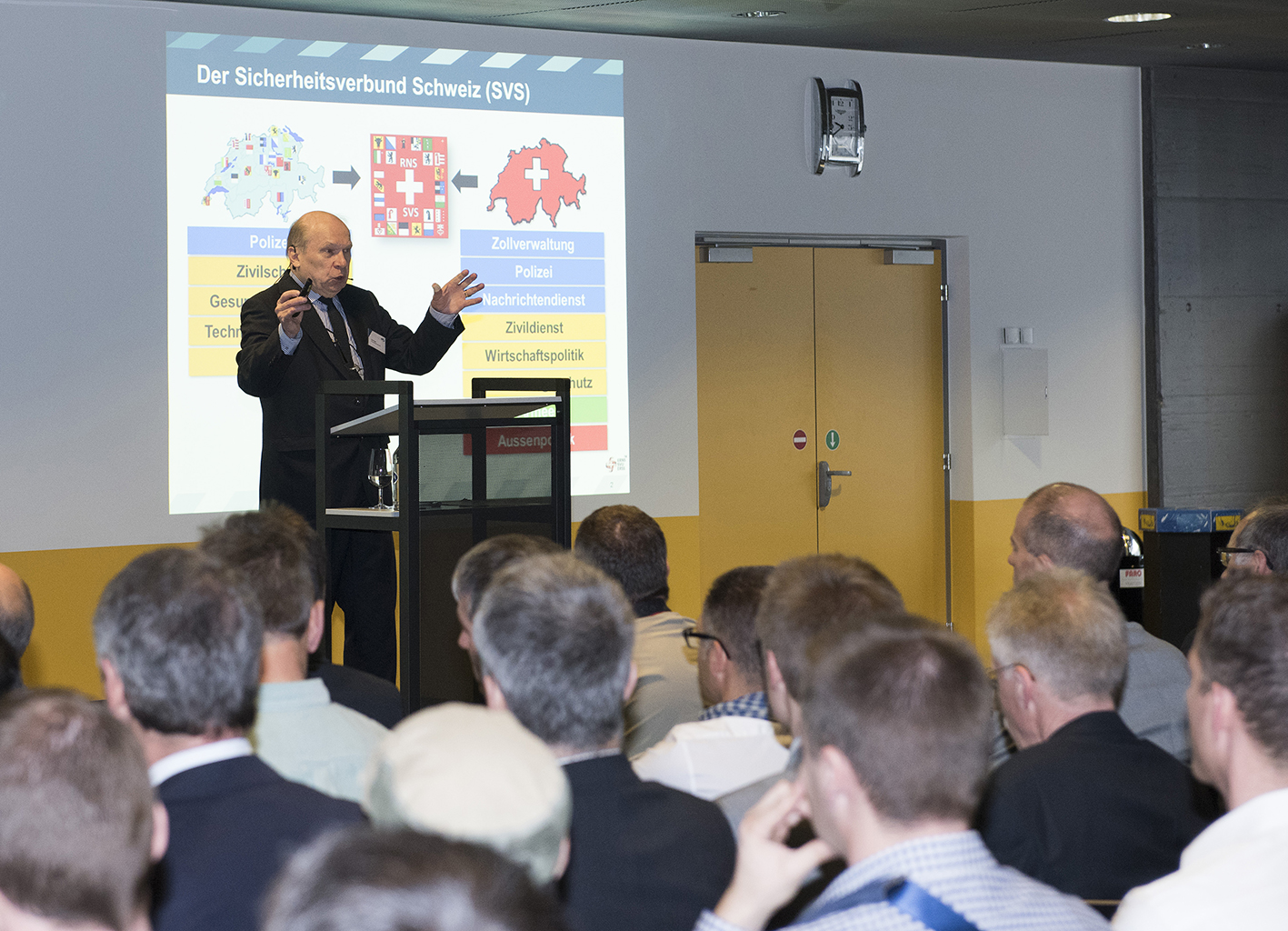
At the 8th Swiss Police Informatics Congress (SPIK) in Bern, SVU head Toni Frisch presented the first findings from the exercise conducted in November. The scenario was a three-month power shortage with a 48-hour complete blackout. In addition, a severe influenza pandemic was rampant. This was the first nationwide crisis management exercise in 17 years: In addition to the federal government, all cantons and some cities, operators of critical infrastructures such as railroad and power grids and the army also took part.
On the whole, the Swiss Security Network exercise can be described as very positive, Frisch summarized in his presentation: "The cooperation of all participants was very constructive and committed. Weaknesses at various levels were identified and measures for future improvement were developed."
Most important, however, is the realization of how vulnerable our society is today, Frisch noted. Because we are used to everything working, we lose our ability to innovate in crisis situations. In addition, he said, we have become much more dependent on electricity in recent years. "We strongly hope that we can sensitize the population with our results without dramatizing."
Good advice - stock
The duration of the crisis, which lasted several months, proved particularly problematic. Due to the breakdown of means of transport and absences due to illness, there was a shortage of personnel everywhere - including in the security organizations. Furthermore, communication would be massively restricted. It is not easy to imagine such a situation, Frisch emphasizes. "The complexity of the situation only becomes clear when you consider the many small things that would no longer function without electricity. This required a high degree of imagination on the part of all exercise participants."
The exercise manager cited the supply of food to the population as a particularly critical point. At a time when hardly anyone stores emergency supplies, he said, supply shortages can quickly have serious consequences. "We clearly need to improve on this point," Frisch said.
Around 600 representatives from the police and business, IT experts from various sectors and participants from politics attended the 8th SPIK on March 26. The annual event is the national platform for the exchange of experience on the topics of police IT and combating cybercrime. In addition to presentations in seven symposia, participants were able to see for themselves the practical benefits of the solutions presented at over 30 exhibition booths.
Photo: Claudio Protopapa, Kapo Bern
Useful forecasting tool
The Zurich City Police have been working with a forecasting tool for residential burglaries for over a year. The tool has proven itself in everyday practice.
Editorial - March 27, 2015
Photo: R. Strässle
Once again, apartment burglars are on the loose. Today they are up to mischief in this neighborhood, the next day in another. But when and where exactly? This question is central to the police force's ability to be on the scene before the perpetrator, so to speak. For this reason, the Zurich city police have been working with a new type of forecasting tool for about a year and a half. But they are not the only ones using the tool; it is also in use in Aargau and Baselland. The software does not have clairvoyant abilities, says Thomas Schweer from the Institute for Pattern-Based Forecasting Technology at the recently conducted Swiss Police Informatics Congress (SPIK) in Bern. "Precobs" is an analysis and progonosis system for fighting crime; it was developed in close cooperation with and for the police. This type of crime hunting goes under the term "predictive policing".
Of course, nothing works without precise information, even with "Precobs," which has to be fed with as much crime data as possible. In this way, the tool does nothing different than any experienced police officer, only much faster, says Dominik Balogh from the Operations Department of the Zurich City Police. The system can recognize offender-related patterns from large amounts of data, which, according to Thomas Schweer, allows conclusions to be drawn and thus a look into the future. International studies show that geographical districts where offenders have been on the move often strike again in a short time and in the immediate vicinity. This is known as the near-repeat phenomenon.
It is important for Thomas Schweer to mention that "Precobs" is merely a tool for police work. But even for Balogh, who has tested the system in everyday practice in Zurich, it is undisputed that the analysis of experienced police officers is still needed. According to him, based on the recently published crime statistics of the Zurich Cantonal Police, residential burglaries have decreased in those city neighborhoods where the forecasting tool has been used. Now the city police wants to extend the system to burglaries of commercial properties, Balogh further said.
Energize at work
A new energy program from PwC aims to promote the health of its employees in a holistic way.
Editorial - March 27, 2015
Relaxed and healthy employees contribute to the success of a company.
PwC Switzerland presents a new health promotion program for its employees. The "Energy to grow your own way" program is based on the four pillars of activity, attitude, nutrition and relaxation. The various measures are designed to ensure that employees have enough energy for professional and private activities.
Specifically, the company is focusing on training in time management and self-organization to reduce stress at work. Sports and meditation courses over lunch are intended to bring movement into everyday life. Informational events with a sleep expert and a quiet room for an occasional power nap are intended to help achieve the required eight hours of sleep; healthier meals in the canteen and fruit and nuts for in-between meals ensure a more balanced diet.
Healthy and relaxed employees are more productive and ultimately move a company forward - this insight is also catching on at PwC.
Together against cyber attacks
The federal government and the business community are working together to protect themselves against cyber risks.
Editorial - March 26, 2015
Cyber threats are among the biggest challenges across industries.
Two years ago, the Federal Council issued a "National strategy to protect Switzerland from cyber risks (NCS)" has been adopted: Cyber risks are to be minimized in cooperation with authorities, industry and the operators of critical infrastructures. The 16 measures for NCS implementation include building additional capabilities and capacities through systematic collaboration with relevant ICT service providers and system suppliers.
To implement this measure, the Federal Reporting and Analysis Centre for Information Assurance (MELANI) and the association "Swiss Cyber Experts (SCE)" founded a public-private partnership (PPP) in 2014. Its aim is to efficiently provide a diagnosis to the injured parties in the event of serious cyber attacks thanks to pooled expert knowledge. The PPP has recently become operational.
Now the business umbrella organization Economiesuisse has also decided to support the initiative. Kurt Lanz of Economiesuisse: "Cyber threats are among the greatest challenges of the present and the future across all industries.
For SCE President Alain Gut, knowledge transfer is at the heart of the collaboration: "Threats to ICT infrastructures today are becoming increasingly sophisticated and are changing very quickly. It is therefore all the more important to exchange up-to-date expert knowledge in order to jointly increase security".
Special show "Safe rescue from heights and depths" at A+A
A special show at A+A 2015 in Düsseldorf will demonstrate how rescues from extreme situations can be successful.
Editorial - March 26, 2015
Practices for rescuing injured persons in extreme situations demonstrated at A+A
At the A+A, international trade fair and congress for safe and healthy working, the special show "Safe rescue from heights and depths" will take place for the first time.
The cooperation partner is the cooperation partner is the Federal Agency for Technical Relief (THW). "Practices for rescuing injured persons from extreme situations - whether above or below water - will be thematized by means of a diving pool and overbuilt climbing equipment," says Birgit Horn, Director of Messe Düsseldorf for A+A 2015, outlining what trade visitors will be able to experience "live" on each day of the trade show in Hall 6. In addition to the safe work of helpers, the focus will be on suitable personal protective equipment (e.g. fall protection).
A+A will take place in Düsseldorf from October 27 to 30, 2015.
Support for new IT department
The Lucerne University of Applied Sciences and Arts wants to finance one third of the construction costs for the new Department of Computer Science through fundraising. The first companies have already pledged.
Editorial - March 25, 2015
On fundraising tour: René Hüsler from the Lucerne University of Applied Sciences and Arts.
The new Department of Computer Science the Lucerne University in Rotkreuz finds prominent support from the business world. The Siemens Building Technologies Division and Roche Diagnostics AG are participating as the first main sponsors. Medela AG and Crypto AG/InfoGuard AG would also donate considerable amounts. In total, these companies plan to contribute 850,000 Swiss francs to the construction, according to the university. "We greatly appreciate this commitment. The generous support also reinforces our decision to strengthen the education of computer scientists with our own department in Rotkreuz," says René Hüsler, director of the new department.
"We have already been working very closely with the Lucerne University of Applied Sciences and Arts in a wide range of disciplines for many years. With our commitment to the new Department of Information Technology, we want to underline the proximity of our research and development in Zug in terms of content and location and make an active contribution to the promotion of young talent," explains Matthias Rebellius, CEO of the Siemens Building Technologies Division. The know-how that will be built up with the new department is of great importance not only for the industry, but for the entire region.
For René Hüsler, fundraising efforts continue. In total, the establishment of the new department will cost three million francs, a third of which is to be raised through donations. The Zug cantonal parliament is expected to decide on the start-up financing of one million francs in June of this year.
The plan is for the new Department of Computer Science to start operations in the fall of 2016 in a temporary solution on the Suurstoffi site in Rotkreuz. In 2019, a new building for the Lucerne University of Applied Sciences and Arts should be ready for occupancy at this location: In addition to the IT campus, a finance campus will also be built. However, the Zug cantonal council must create the planning conditions for this and define the location in the structure plan, according to the university.
What a traffic accident costs
The simulation of a traffic accident shows which emergency processes are triggered by this - and what they cost.
Editorial - March 25, 2015
Simulated traffic accident: Emergency and rescue processes involve a great deal of effort.
On March 25, 2015, for the first time in Switzerland, a Traffic accident simulated under realistic conditions. As part of the "The right thing to do" campaign, the various partner organizations want to raise awareness among road users in the area of road safety and show what costs are actually incurred in the event of an accident. Even though every single life saved is of course priceless, road accidents also often result in high costs for the general public: In Switzerland, these consequential costs add up to around 4.2 billion Swiss francs every year.
The simulation in Mont-sur-Lausanne used a simulated traffic accident to show in detail which emergency and rescue processes are triggered and what costs are ultimately incurred as a result.
Specifically, an accident between two vehicles was simulated, as well as the individual stages of the intervention chain: the arrival of the police and ambulance, the initial medical treatment by the emergency service, the extrication of the trapped occupants from the vehicles by the rescue corps, and finally the helicopter transport of the accident victims to the hospital. An enormous effort that can be triggered by even a minor inattention.
This information and prevention event was organized against the background of the campaign "The right behavior" carried out jointly by the TCS, the Vaud cantonal police, the competent authorities of the city and the canton, the road traffic office, Schutz und Rettung Lausanne and Rega.
Suva uses Big Data
Thanks to data analyses, Suva saves 160 million francs per year.
Editorial - March 25, 2015
Billing analyses on a large scale - this is how Suva finds conspicuous data.
The Suva is now using data traces to keep medical costs under control. It identifies content patterns from millions of invoices and can now use them to identify conspicuous data: for example, diagnoses that do not match medications, or two medications whose effects contradict each other. With Big Data analytics Suva receives information as to whether the service providers are billing correctly and plausibly.
"This invoice control is central for us, as we have to handle our customers' premium money carefully," says Felix Weber, member of Suva's Executive Board. Suva receives 2.3 million invoices a year, and rejects more than 12 percent of them. It can happen, for example, that an accident patient's bills also list his prostate or asthma medication, or that services are billed twice. Since the introduction of the Swiss DRG flat-rate system in 2012, a program developed by Suva can also detect discrepancies in coding. Overall, thanks to Big Data, Suva prevents itself from incorrectly overpaying 160 million francs a year - or around 450,000 francs a day.