Offenses against the penal code (StGB) show a decreasing trend in the canton of Zurich.
Editorial - March 24, 2015
Fewer thefts in 2014
Offenses against the Criminal Code (SCC) have shown a linear downward trend since 2005, with the exception of 2012. In 2014, the 99,000 or so offenses under the Criminal Code were more than 8,700 or 8.1% lower than in the previous year and thus at the lowest level since 1980 (first Crime statistics for the canton of Zurich), as the Zurich Cantonal Police (Kapo) recently announced at its media conference. However, the development in the various crime areas must be differentiated: The decline in overall crime was mainly due to a decrease in property crimes: Here, a decrease of 6,300 offenses or 8.2% was recorded, of which just under one third each was attributable to burglaries and damage to property during burglaries, and another third to pickpocketing, trickery and "normal" thefts.
It is particularly noteworthy that the number of burglaries is at a 20-year low, reaching just 45% of the peak in 1997, the Kapo points out.
Young people drink and smoke less
A survey of 10,000 young people between the ages of 11 and 15 shows that their use of addictive substances has decreased significantly compared to four years ago.
Editorial - March 24, 2015
Cigarette? - No, thanks. Young people smoke and drink less than before.
Addiction prevention seems to be working: Today, young people drink significantly less alcohol and smoke less frequently than four years ago. Only cannabis use has declined less. This is shown by the results of the 2014 student survey, in which around 10,000 students between the ages of 11 and 15 took part.
Addiction Switzerland presented today the concrete Figures of the surveywhich is conducted every four years on behalf of the FOPH: Today, only 10% of 15-year-old boys and 6% of girls of the same age in Switzerland drink alcohol at least once a week - in 2010, the figure was 27% for boys and 13 % for girls.
The numbers are also positive for smoking, with 7% of 15-year-olds smoking daily, compared to 12% in 2010.
Addiction Switzerland calls the decline "gratifying," but the organization also cautions: "It must not be forgotten that adolescents should not consume anything at this age." This is because the growing body is particularly susceptible to damage from substance use.
For Addiction Switzerland, the protection of young people remains a central concern of prevention - but: "Youth protection measures are not enough, especially since young people are oriented towards the adult world. To ensure that young people of today and those of tomorrow continue to exercise restraint in their use of psychoactive substances, addiction prevention must be understood as a task for society as a whole," says the organization.
A+A: New CH representation
Messe Düsseldorf, organizer of A+A among other events, has a new official representative in Switzerland.
Editorial - March 23, 2015
Industrial fire protection is a topic at this year's A+A.
From 27 to 30 October in Düsseldorf will take place the international Trade fair A+A 2015 held. The Fair Düsseldorf as the organizer of A+A, has a new official representative in Switzerland: Zuger Company MAS-Concept AG is now the contact for A+A exhibitors from Switzerland. The company has taken over the tasks of Intermess Dörgeloh AG from Zurich at the beginning of the year.
The trade fair for occupational safety and health prevention also addresses fire protection aspects as part of a special show: The "operational fire protection and emergency management" theme park will be held in Hall 6. Among other things, live demonstrations will be offered to show which measures help prevent accidents and major incidents.
In this theme park, the German Association of Industrial Fire Protection (Bundesverband Betrieblicher Brandschutz Werkfeuerwehrverband Deutschland - WFVD) addresses other issues relating to operational safety and fire protection: How to prepare - for correct alerting in the company, for emergency forces - on hazardous substance release - when handling chemical protective suits - for fires in production and office - in case of strong smoke development
Specialists from the plant fire department association will be available to interested parties as on-site contacts and will demonstrate practical exercises in the plant environment.
As always, the A+A will also be accompanied by a Trade congress accompanied
Real estate monitoring and security
The "59th Real Estate Talk" takes up the topic of "Monitoring and Security of Real Estate".
Editorial - March 23, 2015
New threats are also coming from the Internet.
The topic of security is also becoming increasingly important in the real estate sector. On the one hand, access controls and monitoring of physical facilities are relevant. On the other hand, the security of users (e.g. in the event of fire or earthquake) is also becoming increasingly important. But new threats are also coming from the Internet: Skilled hackers can take control of control systems and gain unauthorized access in this way.
For all the reasons the organizers of the "Real Estate Talks" this time the topic "Monitoring and security of real estate". The event will be held on April 23, 2015 (from 5:30 p.m.) at the Metropol Restaurant in Zurich. The event is organized by the team of the trade magazine "IMMOBILIEN Business" together with that of the "SicherheitsForum".
Difficult customers highest risk factor at work
A Europe-wide survey identifies biggest health and safety risks at work.
Editorial - March 23, 2015
Those who frequently have to deal with difficult customers endanger their health in the long run.
The second Europe-wide survey by the European Agency for Safety and Health at Work (OSHA) on the topic of risks at work shows that the increasing growth of the service industry has a clear impact on risk factors: The three most commonly cited risk factors are difficult customers, students or patients, unhealthy work postures (e.g., prolonged sitting) and repetitive hand and arm movements.
Especially in the case of psychosocial risks, companies are often overburdened: While risk minimization handling is often in place for topics such as machine safety or healthy posture, this is less often the case for risk factors such as high stress, long and inflexible working hours or difficult customers. Around 20% of the companies concerned said they had neither sufficient information nor suitable tools to deal with these risks.
The Osha advises training employees to deal with difficult customers and improve safety, shorten work hours and improve standards.
Surveillance for criminal offenses: New system in operation
The Postal and Telecommunications Traffic Surveillance Service started full operation of a new processing system a few days ago. This is intended to help solve serious crimes.
Editorial - March 20, 2015
Better monitoring capabilities of postal and telecommunications traffic
In criminal proceedings or in the execution of a request for mutual legal assistance, the competent authorities of the cantons and of the Confederation may Service monitoring postal and telecommunications traffic (ÜPF service) with surveillance measures. For this purpose, the ÜPF service operates a central processing system to help solve serious crimes. A few days ago, the system went into full operation, according to the Federal Department of Justice and Police (FDJP).
The ÜPF service is responsible for the legally compliant implementation of surveillance of postal and telecommunications traffic. According to the FDJP, it ensures that the requirements of data protection and information security are met.
The previous monitoring system had reached the end of its life cycle - a replacement procurement became necessary: The first Interception System Switzerland (ISS) project had been delayed several times due to technical complications and delivery problems, according to reports. After the cooperation with the manufacturer had been terminated in September 2013, the FDJP had started the ISS 2 project with the manufacturer of an already evaluated alternative system in December 2013.
Last November, those responsible began productive pilot operation of the new system. As a result, efficiency as well as data protection and information security have been significantly increased, as the FDJP emphasizes.
The functionality of the system is tied to the current legal framework. However, it can be adapted to new legal framework conditions and requirements, for example in the planned revision of the Federal Act on the Surveillance of Postal and Telecommunications Traffic (BÜPF), it concludes. Against a revision of the BÜPF is formed Resistance.
Newly responsible for major projects at Cablex - Mathias Brand
Mathias Brand is a new member of the Cablex Management Board. He is also responsible for major projects at the Swisscom subsidiary.
Editorial - March 20, 2015
New member of the Executive Board and COO
On April 1, 2015, Mathias Brand will take over the function of Chief Operations Officer (COO) from Cablex. He will also become a member of the Executive Board. In his new role, Brand is responsible for all major projects at the Swisscom subsidiary.
Brand succeeds Daniel Binzegger, who took over as CEO of Cablex at the beginning of March, according to a statement. Brand joined the company in October 2009 as site manager in Bern. "With his experience and knowledge, Mathias Brand will be an excellent addition to the Cablex management team and will further develop the Projects division," says Binzegger, adding: "Mathias knows the company and the industry very well and is himself an experienced project manager, which is the best mix for successfully accompanying large projects."
The Swisscom subsidiary specializes in the construction, maintenance and operation of high-performance ICT and network infrastructure solutions.
New safety campaign of scaffolders
The Swiss Scaffolding Contractors Association SGUV wants to prevent dangerous manipulations of scaffolds with its new campaign.
Editorial - March 20, 2015
The new campaign of the SGUV and Suva is in the starting blocks.
In recent years, it has become increasingly apparent that scaffolds are being modified by users. The reasons are manifold, as are the consequences: serious accidents, fatal accidents, insurance costs, material damage and legal sanctions.
Aim of the new Stop! No tampering with the scaffold" campaign of the Swiss Scaffolding Contractors Association SGUV is to prevent modifications to scaffolding that increase the risk of accidents and their serious consequences.
Today's construction projects are complex, the deadlines tight. This increases the importance of planning and work preparation. The various types of work and their processes must be planned and coordinated with foresight. When planning scaffolds, important details must be clarified and then included in the invitation to tender. Today, scaffold adjustments are often unavoidable. Planners (purchasers), erectors and users bear responsibility.
The planner (orderer) coordinates the scaffolding work. He is responsible for maintenance and repair work on the scaffold. The erector creates a safe scaffold. He adapts the scaffold to the new conditions on behalf of the planner. The user may not modify the scaffold. Work must not be carried out on defective scaffolds.
The scaffold erector must be instructed in good time to modify or extend scaffolds. In this way, scaffolds can be prevented from being modified by the users.
A new app from the ZHAW points out local tick risks and provides tips for tick bites.
Editorial - March 19, 2015
Tick bites can lead to serious illness.
Tick bites can be dangerous. The new app "Tick, available now for Apple smartphones and iPads, aims to help protect the population from ticks. However, if someone has already been bitten, the app supports the tick victim with useful tips and a tick diary.
The interactive tool instructs users with a hazard potential map of the Zurich University of Applied Sciences (ZHAW) points out local tick risks. It provides information on effective tick protection and on the two most common diseases caused by tick bites in Switzerland, Lyme borreliosis and early summer meningoencephalitis (TBE).
The app explains the correct removal of a tick and supports the monitoring of one's own health by means of a tick diary. Furthermore, the app contains the map of the areas for which the Federal Office of Public Health (FOPH) has issued a vaccination recommendation against TBE, as well as the TBE vaccination recommendations of the FOPH. The hazard potential map and the tick diary can contribute to fewer cases of Lyme disease with its sometimes drastic complications.
In the tick diary, the affected person records the tick bite, whereupon the app queries the user at regular intervals for Lyme disease symptoms. If Lyme disease is suspected, a visit to the doctor is recommended.
The hazard potential map is a new development by ZHAW and represents the geographical risk of being bitten by a tick. Graphic representations of the five danger levels appear on the main screen and can be applied to the situation on site. The map is based on an algorithm that combines land use statistics from the Swiss Federal Statistical Office (SFSO), meteorological data from Meteogroup and the user's current location.
The FSO data provide information on whether a particular zone consists of settlement areas, arable land, meadowland or forest; ticks prefer the undergrowth at the edges of forests. The meteorological data allow conclusions to be drawn about tick activity: the warmer and wetter the weather, the more active ticks generally are. Together with the user's location data, these data allow a rough estimate of tick activity and thus the risk of being bitten by a tick. However, the hazard potential map cannot tell us anything about whether a tick is infected with Lyme borrelia, the TBE virus or other pathogens.
The Phytomedicine Research Group of the ZHAW developed the app with the support of the FOPH and other partners. It is available free of charge via the iTunes Store, initially in German and French. Development and technical implementation: Andreas Garzotto GmbH, ZHAW Phytomedicine Research Group, ZHAW GIS Research Group, A&K Strategy GmbH. Other project partners: Fondation Sana, Office of Health of the Principality of Liechtenstein, Commission for Technology and Innovation.
McDonalds USA: Burns treated with mustard
Employees at McDonalds in the USA report negligent working conditions.
Editorial - March 18, 2015
Shocking details about workplace safety at McDonalds in the United States were made public by the U.S. group Fight for $15. Employees have to handle hot oil and grills in an "irresponsible manner," the group said. 79% of fast-food employees have been burned at least once in the course of their work - and at McDonalds in particular, they have been advised to use questionable methods of treatment.
Matisse Campbell, an employee at McDonald's in Philadelphia, reported that one of his co-workers suffered a severe burn while disposing of hot oil. His manager advised him to smear mayonnaise on the wound - because: "Our first aid kit is just an empty box," says Campbell.
Brittney Berry, who has worked at McDonald's in Chicago since 2011, slipped on the wet floor and landed with her arm on a hot grill. Her supervisor's idea was to treat the burn with mustard - Berry then had to be taken to the hospital by ambulance and suffers from nerve damage in her arm to this day.
Now, 28 McDonalds employees from 19 different U.S. cities have filed a complaint against the fast-food giant with the Occupational Safety and Health Administration (OSHA). The workers complain that many of the accidents only occur because the pressure at work is extremely high - and that at the same time there are hardly any first aid materials available.
McDonalds is defending itself against the complaints - in its opinion, the activists from Fight for $15 want to harm the corporation: "These complaints are part of a larger strategy by activists to attack our brand and are solely aimed at generating a large media response."
The US Occupational Safety and Health Administration has launched an investigation. McDonalds faces heavy fines - up to US$ 70,000 per case.
"My supervisor advised me to treat my burn with mayonnaise," McDonalds employee Brittney Berry says.
The activists of "Fight for $15" show dangerous working conditions in the fast food industry.
Poisoned peregrine falcons found dead - 10'000 Fr. reward
Two peregrine falcons have been found dead on a high chimney in Wallisellen ZH.
Editorial - March 18, 2015
Found dead: poisoned peregrine falcons
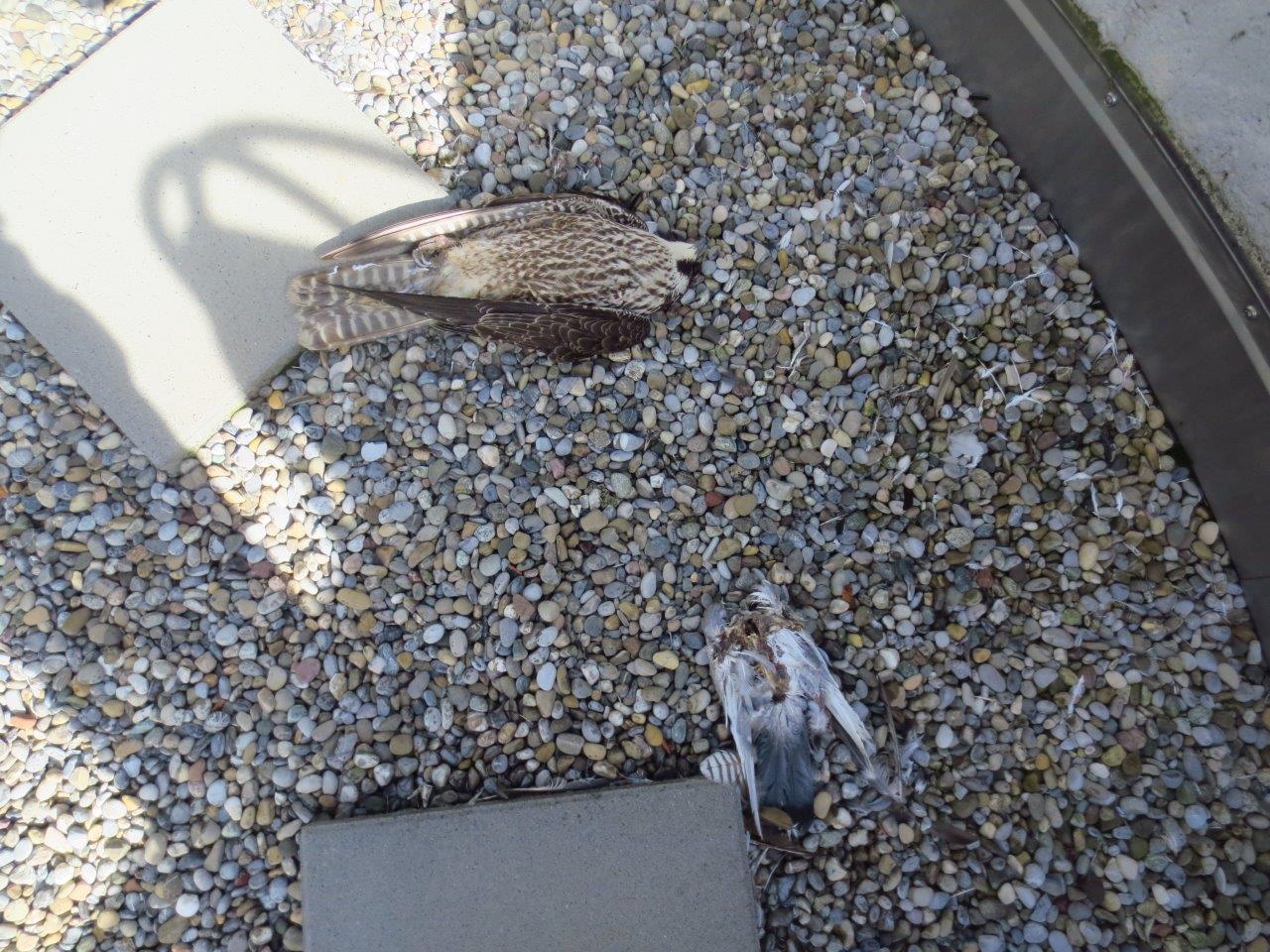
Several passersby recently observed Peregrine falcons in the Hagenholz/Aubrugg region. On March 16, a gamekeeper contacted a specialist from the Animal and Environmental Protection Department of the Zurich Cantonal Police (Kapo) and asked about the whereabouts of the peregrine falcons. The Kapo immediately set out to search for the missing animals, as it writes. On the plateau of the wood-fired power plant Aubrugg, a missing female peregrine falcon and another female were found dead. Next to both birds lay one dead pigeon each. According to the police investigation, the birds of prey were killed by these pigeons.
A liquid poison was applied to the neck of the pigeons by unknown persons. If a peregrine falcon appeared, the pigeon was let fly in its direction. The birds of prey pounced on the prepared pigeons and brought them to the plucking place on the high chimney. While eating the prey, the protected birds came into contact with the poison and died, the Kapo further writes. One of the female birds was about to breed.
According to examinations by specialists of the Forensic Institute Zurich (FOR), the poison is a frass and contact poison.
The SVS/BirdLife Switzerland has offered a reward of up to CHF 10,000 for information leading to the arrest of the perpetrator(s).
Witness appeal: Persons who have made in the time before Monday (16.3.2015) suspicious perceptions in connection with the peregrine falcons and / or conspicuously behaving persons, are asked to report to the cantonal police Zurich, telephone 044 247 22 11.
Unfortunately, this is not the first time that peregrine falcons have been poisoned. More Backgrounds on previous poisoning cases can be read on the Birdlife website.
Police Congress: Predicting home burglaries?
A crime prediction system will be presented for the first time at the Police Informatics Congress 2015.
Editorial - March 18, 2015
Can police predict crimes in the future?
Can home burglaries be predicted in the future thanks to Big Data? When will the smartphone replace the parking fine block? And how will the growing number of passengers at airport customs be managed more efficiently despite increasing security requirements?
These and other questions are the focus of the 8th Swiss Police Informatics Congress' (SPIK), which will take place on March 26. After an opening speech by Toni Frisch, project manager of the 2014 federal security exercise "Pandemic and Power Shortage", the organizers will present approaches to solutions in a total of seven symposia. Among others, Paul Zinniker, Deputy Director of the Federal Intelligence Service (FIS), will speak about regulations and threats.
The event will also be the first time in Europe that a mobile application of a crime prediction system will be presented.
Furthermore, the organization "Harmonization of Police Informatics" gives an insight into the latest advances in its activities. The German racing driver and Paris-Dakar winner Jutta Kleinschmidt will close the event with tales from the world of motorsport.