First "Friendly Workspace" in Ticino

Cooperative Migros Ticino is the 58th company in Switzerland to be awarded the Friendly Workspace label.

Healthy and motivated employees pay off for companies.

Since 2009, Health Promotion Switzerland has been awarding companies that pass an assessment on the topic of occupational health requirements with the label Friendly Workspace off.

For the first time, a company from the canton of Ticino has now also received the award: Cooperativa Migros Ticino is the 58th company in Switzerland to receive the label. A total of almost 190,000 employees work in all the companies that received the award.

In the assessment, companies are evaluated according to six main criteria of occupational health management, which are intended to point the way to a health-promoting company and provide orientation in the design of modern occupational health management.

New Zurich Labor Market Control Office

The canton of Zurich has created a new inspection body to check compliance with wage and working conditions.

A new inspection body monitors working conditions and combats undeclared work.

As of July 1, 2015, inspections regarding compliance with wage and working conditions in industries without a generally binding collective labor agreement (ave GAV) as well as inspections in the area of combating undeclared work will now be carried out by an internal administrative inspection body. Until now, these inspections were carried out by the Association of Labor Inspectorates of the Canton of Zurich (AKZ).

With the establishment of the Labor Market Control Office at the beginning of next month, the Tripartite Commission of the Canton of Zurich (TPK) and the canton will in future have their own internal administrative control organization. Since the TPK and the canton are responsible by law for monitoring the labor market in non-regulated industries and combating undeclared work, and since they have full responsibility in these areas, this innovation is necessary and consistent. Based in the Labor Market Supervision Department of the Office of Economics and Labor (AWA), four labor market inspectors with the support of three administrative staff will in future carry out around 1,300 undeclared work inspections and 2,200 inspections in the TPK's area of responsibility each year.

The canton will continue to cooperate with the Labor Control Office of the Canton of Zurich (AKZ) in the area of statutory interface tasks in regulated industries with ave CLA. The competent control body in these industries is the joint professional commissions, for which the AKZ will continue to carry out controls regarding compliance with wage and working conditions.

Data explosion - and no end in sight

Data explosion - and no end in sight. This can be said on the occasion of the 10th Visual Networking Index, which Cisco has just published.

More and more - faster and faster.

The Visual Networking Index (VNI) is based on independent analyst predictions, real-world mobile data usage metrics, and proprietary surveys by Cisco on IP traffic and services. The IT vendor said the retrospective confirms the accuracy of its predictions: In the fifth VNI, Cisco predicted average annual traffic growth of 34.2% from 2009 to 2014 - in reality, it was 35.6%.

"It took 30 years - from 1984 to the end of 2013 - for a total of two zettabytes (1 billion terabytes) to be transferred over the Internet. But already in 2019, we will reach the same amount of data within one year," says Christian Martin, General Manager of Cisco Switzerland. This shows the speed at which digitization will accelerate and the need to continue investing in broadband expansion.

According to Cisco, three global developments are responsible for the explosive growth:

  • More and more users get access to the Internet. In 2014, there were still 2.8 billion people, or 39% of the world's population. In 2019, the figure will be just over half, at 3.9 billion.
  • The number of devices and connections increasesWhereas last year it was 14 billion, in four years it will be 24 billion (increasingly tablets, smartphones, TVs, M2M connections and wearables such as smartwatches and fitness trackers).
  • Accordingly, Internet providers must continue to develop their networks. For example, in four years, 41% of devices will be IPv6-capable. The average Broadband speed increases by a factor of two from 20.3 to 42.5 MB/s.

Market for electronic safety technology: peak value achieved

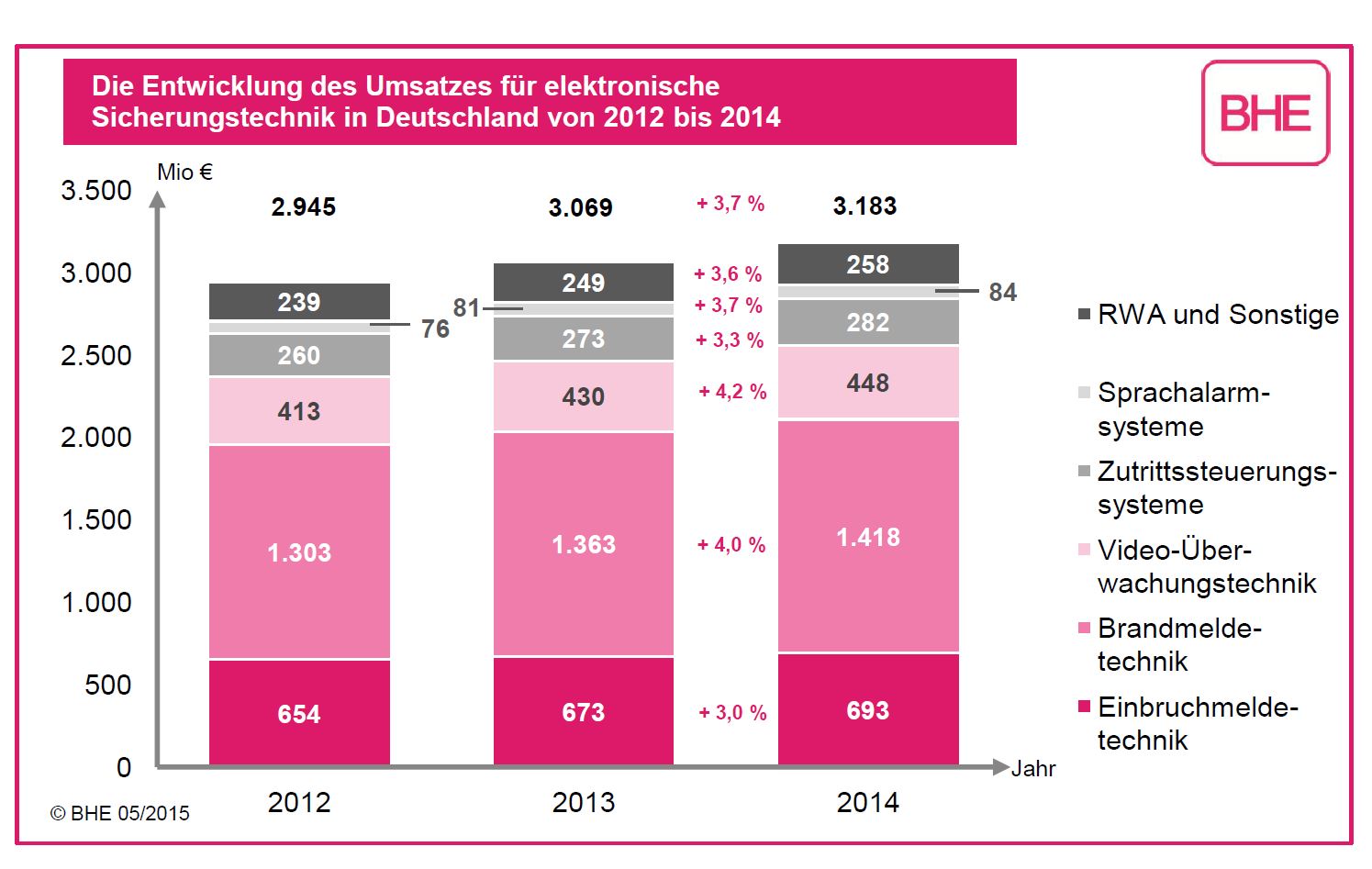
The market for electronic security technology in Germany achieved a new peak value in 2014. According to the BHE Bundesverband Sicherheitstechnik (Federal Association for Security Technology), total sales amounted to around EUR 3.18 billion.

The BHE speaks of the best result since the beginning of the measurements and a significant growth of 3.7% compared to 2013. "All specialist areas of security technology are benefiting from the increase in sales," says Norbert Schaaf from the BHE. The growth in video surveillance technology was particularly significant, he said. Here, an increase in sales of 4.2% to 448 million euros was achieved. Significant gains were also achieved in fire alarm technology (+4% to 1.42 billion euros), voice alarm systems (+3.7% to 84 million euros) and access control (+3.3% to 282 million euros).

"The increasing interest in electronic security technology is due in part to growing demand in the private market," explains BHE Managing Director Urban Brauer. "It is therefore hardly surprising that burglar alarm technology continues to increase its sales. An increase of 3% to 693 million euros is a new record," Brauer continues.

According to the BHE, suppliers of other electronic security systems (+3.6% to 258 million euros) such as smoke and heat extraction systems or escape and rescue routes also benefited from the good business situation.

Fire protection expert - federally recognized

As of now, it is possible in Switzerland to take a federally recognized examination at the level of a higher specialist examination in fire protection.

The State Secretariat for Education, Research and Innovation (SERI) has granted the Association of Cantonal Fire Insurers (VKF) recognized the sponsoring body for the examination Fire Protection Expert with Federal Diploma.

In May 2015, SERI and the VKF signed the examination regulations and the accompanying guide. With this federal recognition, another milestone was reached in the professional world of fire protection, the association writes. In recent years, it has thus created a consistent system of federal qualifications, ranging from the professional examination to the higher technical examination.

The training to become a fire protection expert is aimed at professionals and engineers who have a leading position in preventive fire protection in the municipalities or cantons. In particular, professionals from the economy are addressed. In their working environment, they guarantee that building projects are carried out in accordance with fire protection regulations in terms of the required protection of persons and property. Fire protection experts are called in for medium-sized and large construction projects or for buildings that involve a particular fire risk due to special or different uses and construction methods.

Hearing impaired people do without hearing aids

Only two out of five people with hearing loss wear hearing aids - despite known negative effects on health and career.

There is still a stigma attached to hearing aids.

In Switzerland, one in twelve people report having hearing problems. Among adults, even one in ten is affected. In 2015, the EuroTrak study of the Association of Hearing Aid Suppliers in Switzerland (HSM) examined the "hearing situation" for the second time and documented the circumstances for those affected.

The conclusion: less hearing is accepted untreated for a long time despite negative effects, for example on health or career. This is despite the fact that hearing aid users are less prone to depression or dementia and are better integrated in their private and professional lives.

Worldwide, more than 15% of the adult population is affected by hearing loss, according to the World Health Organization (WHO). In Switzerland, one in ten adults report having hearing problems, according to the 2015 EuroTrak study. Overall, 8% of the Swiss population speak of a hearing loss, and the proportion of hearing losses treated remained constant.

"Since even mild hearing impairment affects daily life and leads to losses in quality of life, there is a need to catch up here.
The study shows that only about 41% of those affected wear a hearing aid," comments Luca Mastroberardino, spokesman for the Association of Hearing Aid Suppliers.

The detailed summary of the study as well as the facts and figures are available at here.

Increasingly important: Big Data

A survey shows that a large majority (74%) expect knowledge gained from big data to have a positive impact on their return on investment within twelve months of implementation. More than half of the participating companies (56%) are already seeing business benefits from Big Data.

Big data with digital globe and magnifying glass, 3d render

Forrester Consulting conducted a survey on behalf of Xerox among 330 top-level business leaders in five Western European countries. This survey revealed that it is mostly poor data quality and a lack of competence in handling data that stand in the way of potential business transformation using Big Data.
"Business leaders understand that rooting data-driven knowledge holds great potential for the business, however, the ground is still quite rocky," says Craig Saunders, Director, Analytics Resource Center, Xerox Consulting and Analytics Services.

The study highlights the current state of Big Data in today's enterprises based on three key trends:

- Big Data is key to many decisions in 2015: three-fifths (61%) of companies surveyed say decisions made during the next year will be based on data-driven knowledge rather than factors such as gut feeling, opinion and experience.

- Inaccurate data can be costly: 70% of organizations are still dealing with inaccurate data sets in their systems. 46% believe that these data sets, some of which are unusable, negatively impact their business and are in urgent need of revision.

- Data security and privacy: 37% of respondents indicated that data security and privacy is one of the biggest challenges when implementing Big Data strategies.

"While there are still challenges, the vast majority of organizations are driving technology to better leverage Big Data in many different use cases," Saunders says. "Of course, though, there is still a wide range of issues that keep leaders up late at night."

Challenges affecting potential future success of Big Data strategies vary from country to country:

- 48% of German companies have data quality problems - more than the European average of 34%

- In Germany, there is also much more focus on data security and privacy than in other European countries (47% compared to the average of 37%)

- In Belgium, the main concerns are lack of user training (39%) and lack of support from management (36%)

- In France, lack of access to customer data and third-party data is a major issue (39%)

- 36% of respondents from the UK believe that a lack of user training stands in the way of successful implementation of a Big Data strategy

- In the Netherlands, 36%, lack of access to internal data due to technical barriers is the biggest challenge


Focus on the fight against terrorism

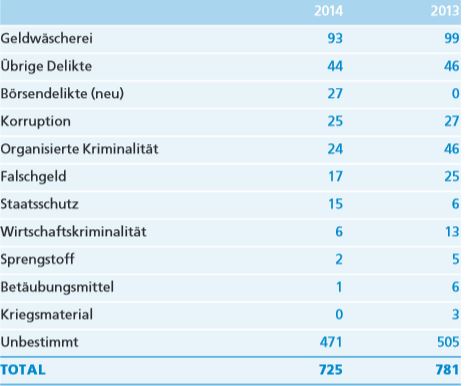
In 2014, the activities of the Federal Office of Police fedpol focused primarily on combating terrorism. The Federal Office heads the "Terrorist Travellers Task Force" created in 2014. Its main objective is to prevent terrorist crimes in Switzerland and the export of terrorism from Switzerland to conflict regions. Other areas of focus for fedpol included investigations into suspected members of criminal organizations, as well as processing reports of money laundering.

Transactions by offense under federal jurisdiction

Although Switzerland is not a priority target of Islamist terrorism, fedpol had to deal with the increased general threat of jihadist-motivated terrorism in 2014 as well. The primary goal is to prevent terrorist attacks in Switzerland. Furthermore, Switzerland should not serve as a financial and logistical base for the planning and execution of such acts, nor as a transit, origin or destination country for jihadist-motivated travelers, according to the statement.

Measures against terrorism: task force set up

Due to the development of the threat situation in Europe, Parliament, the Federal Council and the various authorities involved in counterterrorism decided on various measures in the reporting year. On January 1, 2015, the urgent "Federal Law on the Prohibition of the Al-Qaeda and Islamic State Groups and Related Organizations" entered into force; in the fall of 2014, an interdepartmental "Terrorist Travellers Task Force" was set up under the leadership of fedpol (see report of February 26, 2015).

In its role as the federal judicial police, fedpol investigated several cases on behalf of the Office of the Attorney General of Switzerland in 2014 of individuals suspected of supporting, belonging to or seeking to join jihadist-motivated terrorist organizations.

Propaganda and radicalization via the Internet

The Internet and various social media platforms play a central role in propaganda by jihadist-terrorist groups and in the radicalization of young sympathizers in particular, the Federal Office stresses. As in previous years, fedpol intensively monitors suspected jihadist-terrorist activities on the Internet in Switzerland. Constructive dialogue and cooperation between fedpol and Internet providers are indispensable for successfully combating the activities of jihadist extremists on the Internet.

In addition to combating jihadist activities in the virtual space, fedpol was also involved in 2014 with other forms of Cybercrime employed.

For more information on federal crime fighting, see the fedpol annual report to be taken from the annual report. The statistics for the annual report are here to find.


EU ban on toxic leather

Since May 1, 2015, leather containing chromium VI may not be placed on the market in the EU.

Harmful chromium compounds are often used in tanneries.

The EU has banned the import of leather contaminated with chromium VI since May 1, 2015. The substance can trigger severe contact allergies.

The compound can arise when leather is tanned with chromium III salts. This occurs when the starting compounds are contaminated or the manufacturing processes are of inadequate quality. If there is an allergy, even the smallest amounts of chromium VI can trigger allergic skin eczema. Those affected must therefore avoid contact with products containing chromium VI.

The EU has therefore adopted the long-standing German ban on chromium VI in leather articles. This means that leather articles with prolonged skin contact that contain more than 3 mg/kg of the compound may not be sold.

Nevertheless, workers in tanneries in countries such as China, Indonesia and India are still exposed to chemicals on a daily basis. The German Südwind Institute has therefore launched the campaign "Change your Shoes", which calls for better working and safety conditions for tannery employees. The focus is on improving health protection.

Trade with stolen data flourishes

According to its 2014 annual report, the Federal Office of Police also had to deal intensively with cybercrime.

Data Theft

In the 2014 reporting year, reports of criminal acts against assets received by the Cybercrime Coordination Unit (CYCO) increased markedly, fedpol writes. With the increasing number of internet-enabled devices (especially smartphones) and the growing amount of personal digital data, the misuse of this data for criminal purposes is also becoming more attractive, it said. At the same time, users are often not aware of the risks of these technologies and disclose private information more carelessly.

According to fedpol, the perpetrators are increasingly using malicious software that downloads user data such as stored passwords - for example to e-mail accounts, online payment services or online music stores - from the infected computer. The access data obtained in this way can be sold by the perpetrators in underground forums or used to commit further crimes. This approach is very lucrative for the perpetrators and involves little risk, fedpol emphasizes.

In prosecuting crimes on the Internet, law enforcement agencies face numerous technical and legal challenges that are often deliberately exploited by cybercriminals. The Federal Office therefore relies on national and international cooperation and makes intensive use of the available channels and expert groups of Europol and Interpol.

More on the topic of cybercrime in the fedpol annual report 2014 from page 46.

SVU 14: Now the recommendations are available

Flu, pandemic and power shortage: The partners in the Swiss Security Network had to efficiently master a complex emergency situation. Based on the findings from last November's exercise, 16 recommendations were formulated to improve cooperation between the Confederation, the cantons and the other partners in crisis situations. The Confederation and the cantons also decided to continue the Swiss Security Network.

The new system presented this week in Interlaken Final Report contains the most important findings and recommendations from the Security Network Exercise 2014 (SVU 14), which was conducted last November based on the scenario "Pandemic and Power Shortage Situation". The aim of this exercise was to test the coordination capability and the means available to the Swiss Security Network (SVS) to cope with a complex national crisis situation.

At the conference of the Swiss Security Network, Toni Frisch, project and exercise manager of SVU 14, presented the findings from the exercise and the resulting recommendations for the partners of the Swiss Security Network. In panel discussions and speeches, representatives from the federal government, cantons, municipalities, the private sector and politics commented on the findings and expressed their opinions on the consequences and on the future of national security network exercises. The votes showed the importance of such exercises. For such exercises to bring real added value, the lessons learned and the measures adopted must be addressed and implemented. An exercise but also training culture should definitely be established.

In general, the final report states that the federal agencies, cantons and other partners involved are able to deploy the resources necessary to manage a crisis in a coordinated manner. The considerations made in the context of SVU 14 also allow the identification of other areas that require intervention in the event of a crisis, as well as the measures to be taken to improve the effectiveness of the response capability. The report concludes with 16 recommendations regarding continuing education and training for SVS partners, which should serve to ensure the effectiveness of the collaboration deemed "essential" in the event of an emergency.

Furthermore, the Federal Council and the cantons have decided to continue the structures of the Swiss Security Network after the conclusion of the pilot phase as of the end of 2015. After an in-depth evaluation process, they have come to the conclusion that the SVS is a suitable instrument that enables the Confederation and the cantons to engage in dialogue and coordination in order to address the major challenges in the area of security and to develop solutions while taking federal structures into account.

The Swiss Security Network is limited in time as a pilot project until the end of 2015. The cantons have already decided to continue the SVS at the plenary meeting of the Conference of Cantonal Justice and Police Directors (KKJPD) and the Intergovernmental Conference on Military, Civil Defense and Fire Services (RK MZF) in April 2015. The Federal Council has also recently decided to continue the SVS Switzerland.

It is now also important to implement the specific recommendations from the final report of SVU 14 so that Switzerland is even better prepared for a possible event of national proportions.

(Press release Federal Department of Defense, Civil Protection and Sport)


Are you familiar with the topic of returning to work after an accident?

Test your knowledge on the subject of returning to work after an accident in the Suva quiz. There are travel vouchers to be won.

Is this gentleman allowed to work again? Anyone who knows should take Suva's quiz.

Suva has launched a quiz as part of its new campaign on the topic of getting back to work quickly after an accident.

Participants can test their knowledge of reintegration - and win travel vouchers.

Go to the quiz here.

get_footer();