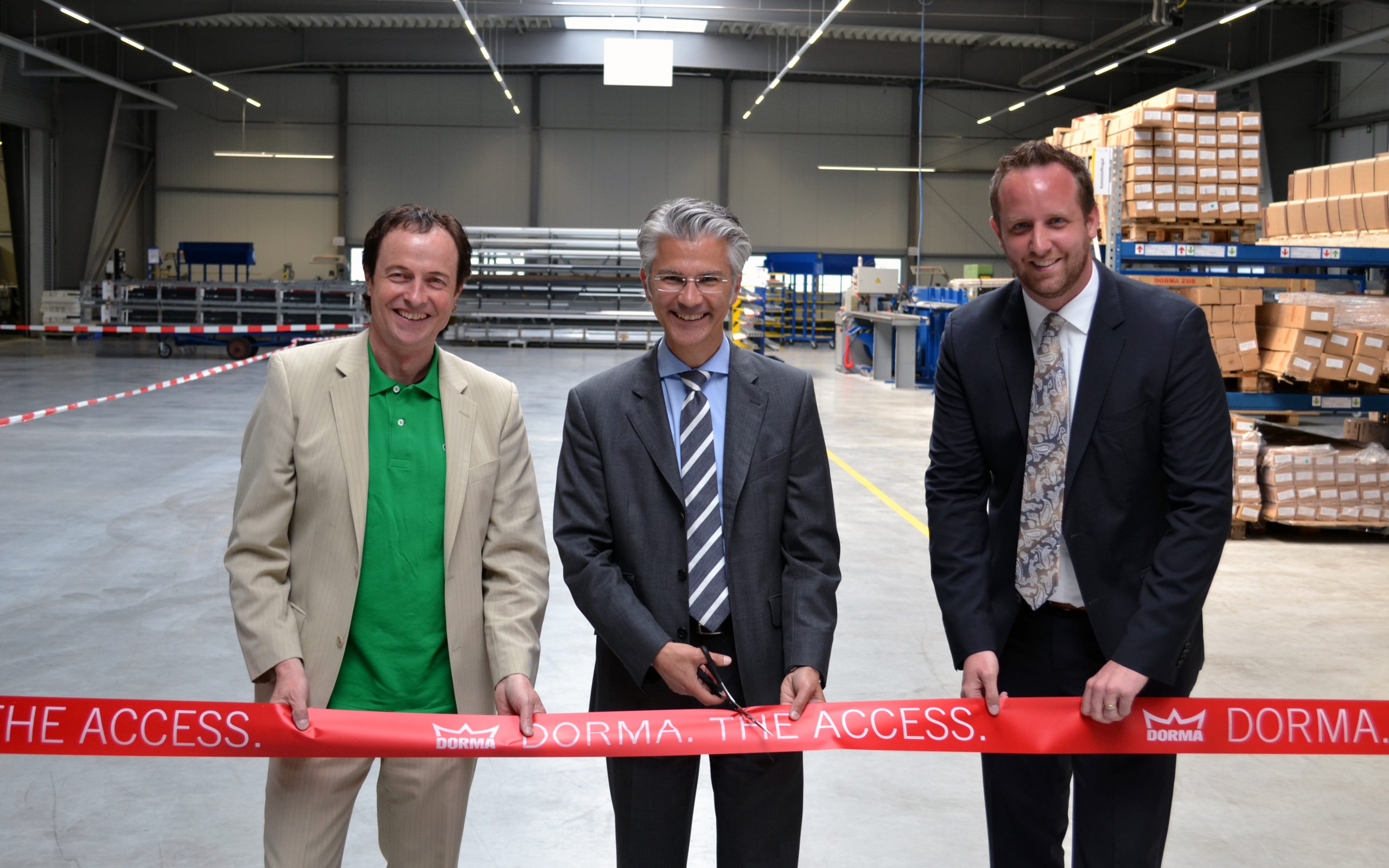
This week, the Dorma company in Zusmarshausen, Bavaria, inaugurated a new production hall.
Editorial - May 21, 2015
The expansion represents an important step at the Zusmarshausen site towards fulfilling its role as a European plant for automatic door systems and sliding doors as Dorma has communicated.
With the expansion, the production area was doubled from previously around 1500 to about 3000 m2. In the course of the new construction, the outdoor area and the social areas for the employees were also redesigned. According to the information provided, the construction investment amounted to around 1.5 million euros. With the expansion, the volume of doors produced on site is expected to double from around 5000 per year in the coming years.
And the doors from Zusmarshausen would go on more and more journeys: Within Europe, for example, customers from Germany, Austria, Switzerland, France, the Netherlands, Belgium, Poland, Italy, Bulgaria, the Czech Republic, England and Russia are supplied. Zusmarshausen is the European door plant, but the products also leave the continent - for example to the Middle East or South Korea.
Identifying people with brain waves
Words that trigger brain waves can be used to identify people, according to researchers at the Basque Center on Cognition, Brain, and Language.
Editorial - May 20, 2015
Will brainwaves soon be used to identify identity?
The researchers recorded signals from 45 volunteers as they read a list of 75 abbreviations. The changes evaluated were so unique that people could be identified to 94%.
Further development necessary
The in "Neurocomputing" published results indicate that brainwaves could be used in security systems to identify identity. Although the accuracy achieved so far would not be sufficient to protect, for example, a room or a computer full of secrets, these results are, however, a promising start.
Methods for identifying people based on electrical brain signals have already been developed in the past. One advantage would be that, unlike passwords or fingerprints, identity can be permanently verified. Continuous verification through facial recognition, ear recognition, or brainwave monitoring, could allow a human to interact with many computer systems or even a range of "smart" objects - without a password.
Until now, however, such approaches have often failed because of the "noise" involved in measuring brain signals and thus the ability to analyze this data. Armstrong's approach solves this problem by focusing on the brain waves of a specific brain region associated with reading and recognizing words. This produces clearer signals that can be analyzed more quickly.
Biometrics completely reimagined
The signals arise when a person accesses his semantic memory. Episodic memories record our experiences, but semantic memories capture the meaning of specific words. The collection of meanings that people associate with words may differ slightly from person to person. Thus, an individual pattern becomes apparent.
Unlike episodic memories, semantic ones change little. For example, if one is stung by a bee, there are likely to be differences in the neurons of episodic memory when reading the word "bee." However, the neurons of semantic memory are likely to behave similarly as before this event.
According to Armstrong, the new method can be further developed to provide a more personal and harder-to-crack alternative to fingerprint recognition or iris scans. The researcher points to a case in Malaysia. In 2005, carjackers removed the owner's fingertips so they could start the car. However, a brain cannot simply be removed.
Kevin Bowyer from the University of Notre Dame According to the expert, the approach does change the concept of biometrics. However, the expert points out that the method is currently far less accurate than scanning a fingerprint or iris. Since three electrodes have to be placed on the head, the method is also more difficult to use.
Suva calls for slow return to work for accident victims
Suva requires that injured employees in minor cases should not be 100% on sick leave.
Editorial - May 20, 2015
Being bored until the injury is completely healed doesn't have to be - at least partial reintegration is often possible sooner.
Suva complains that doctors often write employees who have had an accident 100% incapacitated for work - and this until they have fully recovered. And this is despite the fact that they are often at least partially fit for work again.
This is not ideal for several reasons: Firstly, reintegration becomes more difficult the longer the absence lasts; secondly, this causes unnecessarily high costs.
Suva therefore calls for people who have had an accident to be brought back to work as early as possible, at least gradually. This could, for example, initially be done with a part-time workload or a sheltered job.
To achieve this, Suva also provides employers with a newly revised form in which they can describe the workplace and activities of the injured person with minimal effort and provide this information to the attending physician. This tool is intended to make it easier for the doctor to assess the possibilities for reintegration.
Information Security in Healthcare
In June, Switzerland will host its first conference dedicated to the topic of information security in healthcare.
Personal data - especially medical data - must be secure. Politicians and the public agree on this. However, increasing cost pressure in the medical sector is forcing service providers such as doctors, hospitals and health insurers to process more and more data at an ever faster pace. Moreover, a lot of patient data has to be sent from one institution to another: a security risk?
"The various techniques have their advantages and disadvantages," says Peter E. Fischer, head of the Information Security Competence Center at Lucerne University of Applied Sciences and Arts. "Many doctors today still prefer to send patient data by fax rather than e-mail, assuming that a fax, once in transit, is more difficult to intercept than an e-mail," he says. But for that calculation to work out, he says, the recipients' fax machine should not be located in an open-plan office. In addition, it's easy to make a mistake when entering fax numbers, he adds. "A secure Internet platform for the exchange, reliable encryption of the e-mails or strict anonymization of the data may therefore be the better solution."
That is why data protection is a central topic at Switzerland's first "Information Security in Health" conference at the Lucerne University of Applied Sciences and Arts in Rotkreuz. Here, solution providers, users and decision-makers will come together to discuss how best to implement efficient and at the same time secure data collection, transmission and storage.
(Press release HSLU)
Glutz and Halter cooperate
Solothurn-based Glutz AG, a full-service provider of access systems, and Halter AG in Frutigen will be working together in the future. Glutz is expanding its product portfolio with mechanical locking systems from Halter and now offers integrated mechanical and electronic access solutions, according to the company.
Editorial - May 20, 2015
New collaboration: Glutz AG and Halter AG.
The two traditional Swiss companies Glutz and Holder are pooling their expertise: Halter will manufacture two mechanical products for Glutz. The two new systems, "Glutz mAccess Basic" and "Glutz mAccess Pro", expand the supplier's product portfolio - especially for end-to-end access solutions, the company emphasizes. Halter manufactures these systems specifically for Glutz.
Joint growth strategy
Through the cooperation, the two companies are striving for a joint growth strategy. Hanspeter Halter, CEO of Halter, explains: "The common pursuit of quality and growth as well as a strong drive for innovation unites our companies and forms a good basis for cooperation." Glutz CEO Peter Riedweg and Bruno Räz, Head of Business Development Access Systems, also emphasize the great benefits of the cooperation: "Thanks to the cooperation, we will be able to supply new projects even more comprehensively from a single source in the future and, on the other hand, retrofit current Halter customers with electronic access systems.
The new mechanical products will be launched via Glutz sales channels from August 2015, according to the statement. Halter AG will continue to distribute its mechanical locking systems "First Alpha" and "Norma" independently, it concludes.
Update access control
Those who want to protect their facilities or prevent the theft of intellectual property are probably most likely to start by planning an appropriate access control system.
Editorial - May 20, 2015
Access control (ZuKo) should not be an obstacle to authorized persons gaining access, but should clearly deny access to unauthorized persons. Based on structural, organizational and technical measures, attempts are made to successfully master this balancing act. Access control is an important preventive measure. It deters potential offenders, especially opportunistic offenders.
Access control systems have changed dramatically in recent years thanks to increasingly sophisticated technologies. This raises questions: Medium card or smartphone? What are the requirements of an operator in the first place? Should the ZuKo system be networked in the sense of an integral safety concept? What about merging with building technology? Where are the limits of system integration?
The event is organized by Save AG, a company of the galledia group.
Special edition appears
At the beginning of June, another special issue of the trade journal SicherheitsForum will be published, this time on the subject of access control. In addition to in-depth technical articles on the subject (planning aspects, data protection, practical examples, etc.), an almost 40-page market overview shows the ZuKo performance profile of manufacturers and specialist dealers.
A view copy of the special edition access control can be here be requested.
Burnout should not become a recognized occupational disease
The Federal Council does not want to include burnout syndrome in the list of recognized occupational diseases.
Editorial - 19 May 2015
The Federal Council considers the current preventive measures against burnout to be sufficient.
According to the will of the Federal Council, burnout syndrome should not be included in the catalog of occupational diseases of the Ordinance on Accident Insurance (VUV). He emphasized this in his response to a parliamentary initiative by Berberat Didier.
On the one hand, the Federal Council justifies this by saying that it breaks the causality principle of the UVG, since burnout depends on several factors - in addition to work, family, financial and cultural reasons also play a role. On the other hand, it fears an "unforeseeable expansion of cases" due to the unclear definition of burnout.
Similarly, the Federal Council does not consider it necessary to amend the law in order to intensify prevention. It considers the current and planned measures to be "sufficient" from today's perspective.
Privileged IT access: monitoring guide
There are privileged IT accesses in every company. Therefore, the question arises: How do you protect sensitive company data from errors or employee manipulation?
Editorial - 19 May 2015
One of IT's biggest challenges is to prevent privileged users from doing something in systems that they are not allowed to do. The activities of website visitors are subject to restrictions, to be sure. However, the same is not true for employees and certainly not for company system administrators. The freedom of users grows with their access rights: The higher their rights in IT systems, the greater the risks they pose to the company.
System administrators are the most powerful users in the IT environment. They run the entire IT infrastructure with sensitive data and critical business systems. For those new to the position of CIO, monitoring staff may be a headache. How do you protect sensitive corporate data from mistakes or employee tampering?
SecuMedia Verlags-GmbH, Germany, publishes white papers on various security topics at regular intervals.
Security technology: optimal business situation
According to the BHE Bundesverband Sicherheitstechnik (Federal Association for Security Technology), specialist installers are very satisfied with the business situation.
Editorial - 19 May 2015
The rising number of residential burglaries is stimulating business.
The growing interest of private individuals in security technologies is also making itself felt among specialist installers: In the current economic survey of the BHE Federal Association for Safety Technology in Germany, specialist installers rated the business situation in the private sector with an average of 2.55 on the school grade scale, the best value since measurements began, as BHE writes.
"The survey confirms the growing demand from private users," says BHE Managing Director Urban Brauer. This development is due, among other things, to the increasing number of home burglaries in Germany over the last few years.
The positive development of demand is probably also a reason for the overall high level of satisfaction with the overall business situation. This was awarded an index of 1.97 by the specialist installers, also a new best mark in the BHE survey.
The future business situation was also assessed more positively than ever before (2.11). It is therefore hardly surprising that around 51% of the companies surveyed were planning to recruit further employees and 48% would like to maintain their headcount.
Crib work burdened
Educators often suffer from back or joint pain, but simple remedies can help a lot.
Editorial - May 18, 2015
Employees in daycare centers often suffer from musculoskeletal disorders - for example, due to ergonomically inadequate furniture.
It probably comes as no surprise to anyone who has children of their own: the work of educators in daycare centers puts a lot of strain on their musculoskeletal system.
In a study, the German Social Accident Insurance DGUV has for the first time investigated the stress situation of pedagogical staff and developed measures to prevent complaints and illnesses in the future.
The project, ErgoKita The study, which is known as the "Musculoskeletal System Study", showed in detail how much strain is placed on the musculoskeletal system of nursery school teachers in Germany and which working conditions are the cause of this.
Subsequently, exemplary changes were implemented in six facilities and the effects they brought were observed. For example, ergonomic furniture was installed, behavioral training was carried out and the rooms were redesigned in such a way that rearrangement work was reduced as much as possible.
The result: Unfavorable body hatching could be sustainably avoided by the measures.
Companies underestimate the danger posed by cyberattacks, according to a study by management consultants A.T. Kearney. That can be expensive: Estimates by relevant institutions of global damage range from $400 billion to $2.2 trillion. Added to this are damage to the company's image and loss of trust.
Editorial - May 18, 2015
Cyberattacks can be costly.
In the future, the frequency and extent of cyberattacks will continue to increase, as the consultancy writes. To minimize risks, it is advisable to take a holistic approach to information security. in five dimensions to address: Strategy, Organization, Processes, Technology and Culture.
"First of all, companies need to understand that information security risks are business risks. The responsibility for managing these risks lies with the company's management, not with the IT department or the CIO," explains Michael Römer, Partner at A.T. Kearney and Head of Digital Business Consulting in Europe.
The methods of information security attacks would change rapidly, while the risk and subsequent costs of inadequate security measures would continue to rise. "The next cyberattack is as hard to predict as the next earthquake, however, some trends are emerging. The estimated cost of successful attacks is between $400 billion and $2.2 trillion annually worldwide. This is roughly equivalent to the gross domestic product of Austria and Brazil, respectively, and long-term consequences such as image damage due to loss of trust can hardly be adequately taken into account," says Boris Piwinger, Senior Manager and Head of Information Security Consulting at A.T. Kearney.
With increasing digitization and the inevitable security breaches that come with it, the extent and frequency of attacks would also increase. Piwinger sees the following trends in particular:
global monitoring
Targeted weakening of information security technology
Attack-as-a-Service (AaaS) offerings
massive attacks on infrastructures
industrial control systems
Extortion is also a possible business model for the attackers. They threatened to massively inflate a previously credibly claimed damage until the "ransom" is paid, as emphasized.
How to minimize security risks?
The study shows that companies that are exemplary in information security consistently address five areas to minimize risk:
Strategy
Organization
Processes
Technology
Culture
"Security problems are rarely due to flaws in just one of these areas. Successful hackers typically use a combination of different vulnerabilities," Piwinger explains.
"Companies that want to minimize their security risks need a security strategy that is closely linked to the corporate strategy, a balanced organizational setup in which difficult decisions can be managed, well thought-out and practiced processes for assessing and handling risks, efficient use of technology and, above all, a strong corporate culture that perceives information security as a value proposition and a shared responsibility of the entire organization," concludes Michael Römer.
Bosch: New Head of Public Affairs
On July 1, 2015, Christoph Hampe (48) will become the new Head of Public Affairs at Bosch Sicherheitssysteme GmbH.
Editorial - May 18, 2015
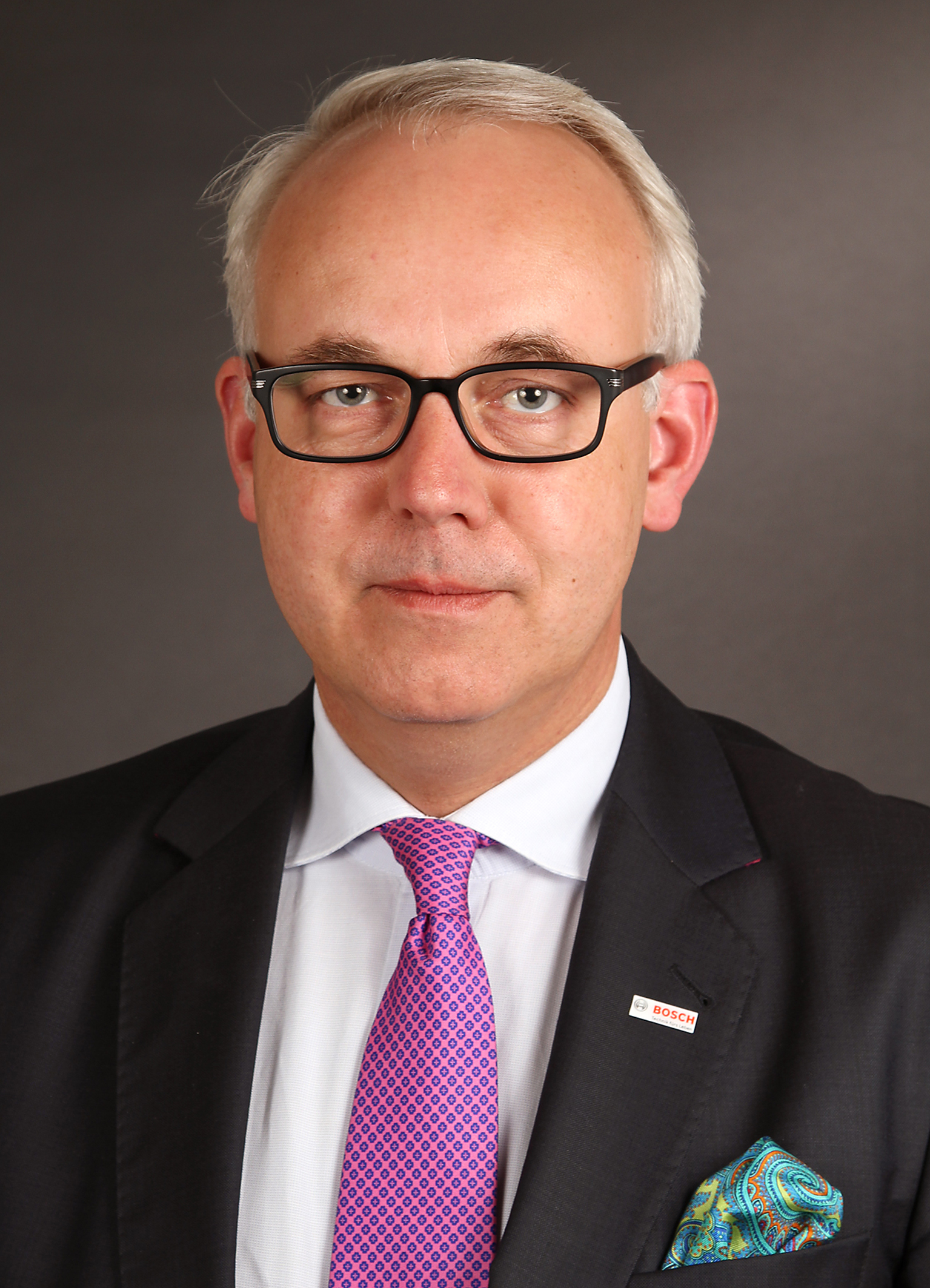
Christoph Hampe (48)
In this position, Hampe is responsible for association and committee work as well as government contacts for Bosch Security Systems in Berlin, according to the media release. The lawyer has already been with the company for ten years. In the past five years, Hampe has been responsible for the product business in Russia. Before that, he was responsible in various functions for sales and marketing for the building security product area in Germany.
The previous Head of Public Affairs, Michael von Foerster (48), will leave the company on June 30, 2015 to pursue a new professional challenge, according to a statement.