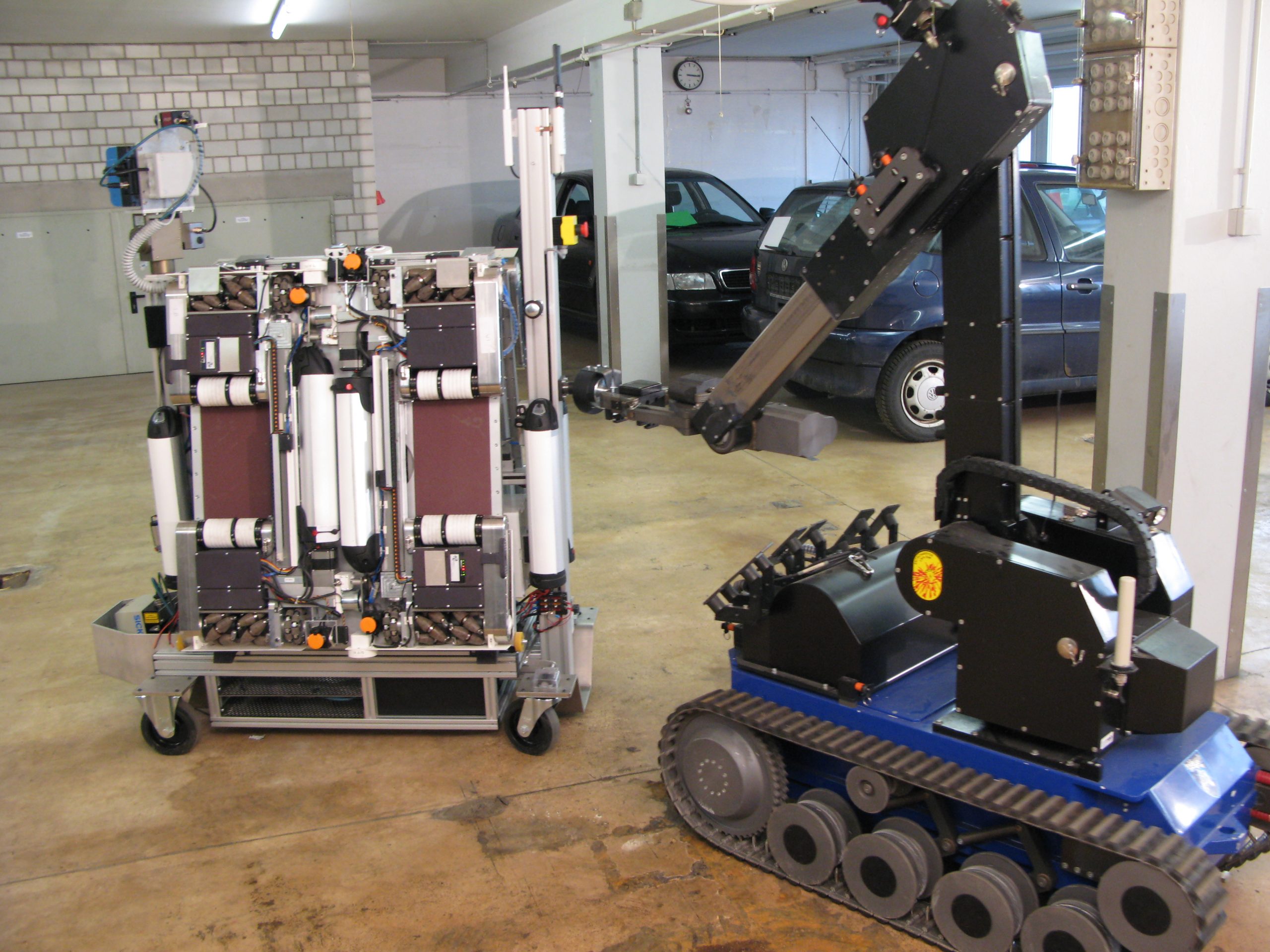
If a car bomb is suspected, robots could in future serve the police or the army as a mobile evacuation squad.
Editorial - May 28, 2015
The robot is ready to start.
As part of the EU FP7 research program, researchers from the Zurich University of Applied Sciences (ZHAW), together with partner institutions from four countries, have developed the "Autonomous Vehicle Emergency Recovery Tool"(Avert) has been developed. It enables emergency services to quickly and safely remove blocking or suspicious vehicles from sensitive positions - for example, in parking garages, underground garages or tunnels.
Equipped with cameras and sensors, the robot creates a 3D image of the entire scene on site and subsequently moves autonomously to the vicinity of the vehicle to be moved. The robot then deploys four flat mini-robots - known as "bogies" - equipped with scanners. These autonomously drive under the wheels of the vehicle and lift it a few centimeters. The emergency services then have the option of driving the vehicle away remotely or semi-automatically. This is made possible by a system developed at the Institute for Mechatronic Systems (IMS) at the ZHAW School of Engineering developed control system for the Avert overall system, as it is called.
Previous methods of removing such vehicles were very dangerous for the defusers, especially if the vehicles were located in hard-to-reach places. In collaboration with bomb disposal specialists in Germany, the United Kingdom and Switzerland (Zurich Airport Police and the Scientific Service of the Zurich City Police), Avert was tailored to practical needs, the idw information service writes. Over the past few months, the robot has already proven itself in various test scenarios.
Suspicion of bribery - football officials arrested
By order of the Federal Office of Justice, several football officials were arrested in Zurich on May 27 and placed in extradition custody. They are suspected of having accepted bribes worth millions.
Editorial - May 27, 2015
The detention order issued by the Federal Office of Justice (FOJ) is based on arrest requests from the US authorities. The prosecutor's office responsible for the Eastern District of New York is investigating these individuals on suspicion of accepting bribes and hidden commissions from the early 1990s until today. The alleged bribers are said to be representatives of sports media and sports marketing companies. Those arrested are alleged to have been involved in payments to high-ranking football officials, i.e. delegates of Fifa and other officials of Fifa sub-organizations, amounting to more than $100 million. In return, they allegedly received media, marketing and sponsorship rights in the hosting of soccer tournaments in the U.S. and Latin America, according to the FOJ. According to the request for arrest, these criminal acts were agreed upon and prepared in the USA; in addition, payments were processed via US banks.
The Zurich cantonal police have conducted hearings on the US arrest requests on behalf of the FOJ. If the wanted person agrees to immediate extradition at the hearing, a simplified procedure will be carried out, according to the statement. In this case, the FOJ can immediately approve the extradition to the US and arrange for its execution. If, on the other hand, the wanted person resists extradition, the FOJ will ask the US to submit a formal extradition request within the 40-day period provided for in the bilateral extradition treaty. According to the FOJ, the majority of those arrested oppose extradition to the USA.
Another separate case has been opened in connection with irregularities surrounding football tournaments: The Office of the Attorney General of Switzerland has opened criminal proceedings against unknown persons in connection with the awarding of the 2018 World Cup in Russia and the 2022 World Cup in Qatar on suspicion of disloyal business management and money laundering. Electronic data and documents were seized at Fifa's headquarters in Zurich. These proceedings stem from a criminal complaint filed by Fifa with the Office of the Attorney General of Switzerland on November 18, 2014.
Fifa says it welcomes the authority's action to expose wrongdoing in the football business. More information from Fifa here (Video of the Fifa press conference of 27.5.).
Back pain: A question of mechanics
Empa researchers can show for the first time how wear and tear on vertebral bodies and intervertebral discs occurs. This makes it easier to select the right therapy.
Editorial - May 27, 2015
With the help of the Open Sim program from Stanford University, Empa calculates the distribution of forces in the back when a person lifts a load. (Image: Empa)
Together with the University of Pittsburgh and Balgrist University Hospital, Empa is decoding the mechanics of the lower back vertebrae. The researchers can now show how wear and tear on the vertebral bodies and intervertebral discs occurs. This will make it easier to select the right therapy.
Some say back pain is the price of walking upright. The others say that the problem of back pain started when man sat down to think: lack of exercise weakens the muscles, plus stress in private life or at work. The back muscles cramp and hurt.
In most cases, the problem can be solved by loosening and strengthening the back muscles. But this does not work for one in seven sufferers; even the administration of opiates then no longer helps. Only surgery can end the suffering. In severe cases, defective vertebrae or intervertebral discs are bridged with a metal construction (intervertebral fusion). The fixed segment ossifies and can initially no longer cause pain. But such repair operations bring patients relief for only a few years, after which the problem recurs in the adjacent vertebrae. The question is: Why is this, and how could it be prevented?
Bernhard Weisse and his team at Empa are researching precisely these mechanical issues. To understand why and how quickly an intervertebral disc wears out, researchers need to know the forces acting in this area. And that, in turn, requires precise knowledge of the shape, elasticity and mobility of the individual elements - it's a question for mechanical engineers.
The skeleton simulator In a first step, the Empa researchers fine-tuned the theoretical basis: Weiss' team fed spinal geometry data from 81 patients into the computer program Open Sim - a simulation program for the human musculoskeletal system developed by Stanford University and used worldwide. Then the task was to map the biomechanics as accurately as possible in the computer simulation: Does an intervertebral disc behave like a ball-and-socket joint? Or more like a rubber bearing? What influence do the muscles have on this - does the rubber bearing always remain the same stiffness, or does the stiffness change, depending on the angle of bending? For this purpose, Empa collaborated with the Laboratory of Orthopedic Biomechanics at Balgrist University Hospital (University of Zurich) and the Institute of Biomechanics at ETH Zurich. With the help of the computer model, the scientists succeeded in reproducing the mechanics. The result: in people with a certain spinal misalignment, the intervertebral discs are already under up to 34 percent more strain in a healthy state. If an intervertebral disc breaks down and is bridged, the load in the neighboring joints increases even further and can be up to 45 percent higher than in people without this malposition.
Individual therapy recommendations become possible But computer analysis of a health problem alone is not enough. The goal is to make an individual diagnosis for each patient and recommend the appropriate therapy. A collaboration with U.S. scientists, funded by the Swiss National Science Foundation, helped here: researchers at the University of Pittsburgh have developed a novel 3-D X-ray video system. Called "Digital Stereo-X-Ray Imaging" (DSX), it can reproduce the movement of the spine at 250 frames per second, while the position of the vertebrae can be seen with an accuracy of 0.2 millimeters. The trick is that the blurred X-ray images of the movement are combined with sharp CT images of the patient lying still in the computer.
One of the researchers working there, Ameet Aiyangar, was already a guest scientist at Empa in 2009 and is now returning to Empa. In Pittsburgh, he had twelve healthy people lift weights and produced high-resolution films of their spinal movement. Currently, Aiyangar is in the process of matching the captured X-ray films with computer models of each subject. Once the model is consistent for healthy people, the researchers plan to use this method to study the problem of spondylodesis (vertebral body locking). To do this, patients are filmed before and after surgery with the DSX system and the movement of their vertebrae is analyzed. This makes it possible to determine what forces were acting in the lower spine before surgery and what the bridging of the vertebrae has changed about this distribution of forces. The study will help to better understand the wear and tear of spinal vertebrae and more accurately localize the cause of lower back pain.In the future, this type of computer analysis could be available for all back surgery patients.
(Text: Empa)
Stricter export for surveillance goods
The Federal Council recently adopted an additional criterion for assessing the export and placement of goods for Internet and mobile phone monitoring from Switzerland.
Editorial - May 27, 2015
Export goods for Internet and mobile phone monitoring are subject to stricter criteria.
Goods for internet and mobile phone surveillance are goods with the possibility of civilian and military use (so-called dual-use goods). The export of such goods from Switzerland has been controlled on the basis of international agreements since 2012. Exports from Switzerland are subject to the following requirements based on the goods control legislation of State Secretariat for Economic Affairs (Seco) a permit must be obtained.
The goods control legislation provides only limited possibilities for rejecting applications for the export or brokering of goods for internet and mobile phone surveillance. The Federal Council has now decided to create a new criterion for the rejection of such applications by means of an unconstitutional ordinance based on Article 184 paragraph 3 of the Federal Constitution. An individual license for the export of goods for Internet and mobile phone surveillance will be denied in the future if there is reason to believe that the goods to be exported or brokered will be used by the final recipient as a means of repression, according to the Seco release. In this context, the transfer of intangible property (including know-how and the granting of rights), which concerns goods for internet and mobile phone surveillance, will now also be subject to the authorization requirement. The constitutional decree entered into force on May 13, 2015. It is limited to four years.
Secure data network
Recently, the Federal Council held a debate on a secure data interconnection network that would ensure connectivity between the federal government and the cantons even in crisis situations. Now the ball is in the DDPS's court.
Editorial - May 27, 2015
Especially important in times of crisis: a secure data network.
Command and control capability at the federal and cantonal levels in the event of a power blackout and power shortage was a central theme of the 2014 Security Network Exercise, which showed that a prolonged shortage of electricity would create a complex national emergency. One aspect of this would be technically related command and control problems because normal means of communication would not work after a short period of time. Therefore, there is a need for a crisis- and tap-proof, nationwide data interconnection network that would link those federal, cantonal and third-party agencies that are essential to the security and supply of the country. So far, only the army has transmission networks that meet these requirements.
In the future, a secure data network (SDVN) is to enable connections between partners of the Swiss Security Network even in crises and emergencies, i.e. between the command and control facilities of the national government, all federal departments, the cantons and the operators of critical infrastructures (e.g. nuclear power plants or national airports). The SDVN is also to be used for daily communication and secure data exchange.
The SDVN and the specialist applications based on it are also to be protected against cyber attacks. The network is to use existing or planned fiber-optic infrastructure, primarily from the Armed Forces Command and Control Network Switzerland. Network components from other civilian federal agencies will also be added.
The investment for the project is estimated at between 55 and 60 million Swiss francs, with the exact number of connection points still to be agreed with the users. The annual operating costs, which are incurred exclusively for the SDVN, will amount to about 11 million Swiss francs per year, according to current estimates. The operating costs are to be determined in more detail in the course of further clarifications and divided among the users according to the polluter-pays principle.
The Political Platform of the Swiss Security Network (heads of the DDPS and FDJP as well as the presidents of the Conference of Cantonal Justice and Police Directors KKJPD and the Conference of Cantonal Military, Civil Protection and Fire Service Directors RK MZF) welcomes this project. The KKJPD and the RK MZF also unanimously welcomed the project at their annual conference on 13 November 2014.
As a next step, the Federal Council has instructed the DDPS to press ahead with the project and make it more concrete. By the fall, the DDPS will examine distribution keys for the investment and operating costs with the intended users. These will then be presented to the Federal Council. The Federal Council intends to submit a dispatch to parliament on the actual implementation of the SDVN, probably in 2016.
Press release VBS
DDoS attacks: Attention blackmail
Various cases indicate an increase in DDoS attacks, the main purpose of which is to extort money. This is according to the Reporting and Analysis Center for Information Assurance MELANI. It is therefore publishing a guide with various protective measures.
Editorial - May 26, 2015
Indications of increased money extortion
Extortion is currently one of the preferred methods of cybercriminals to get money quickly, MROS writes. Various methods are used for this purpose, including attacks on the availability of Internet services. In such cases, an attacker tries to make a targeted website or Internet service inaccessible: He floods it with requests. If these requests come from not just one but a number of sources, they are referred to as "distributed" attacks (distributed denial of service, DDoS). This can lead to a great loss of profit for the owner. The extortionist demands money to stop an attack that has already been started or not to start it at all.
What to do. The Observatory recommends:
Not to respond to the extortion. It is quite possible that even after an initial payment, the attacks will continue and the extortionists will try to extort more money.
Contact the cantonal police station and discuss the possibilities of filing a criminal complaint.
If the criminals threaten a DDoS attack, it is recommended to take technical measures with the hoster/upstream provider to prepare for a possible attack.
Even if you are not currently threatened, but the website is still essential for the functioning of the company, preventive protection measures are indicated.
MELANI has published a document on the topic of DDoS attacks and on general ways to counter this phenomenon.
Kaba shareholders give green light for merger
At an Extraordinary General Meeting held on May 22, the shareholders of Kaba Holding AG approved all proposals by a large majority. This means that the key conditions for the planned merger with the Dorma Group have been met.
Editorial - May 26, 2015
Hans Gummert (Dorma): "The outcome of the Extraordinary General Meeting is an important step on the way to merging two premium brands into one globally leading company. "
The Extraordinary General Meeting (AGM) was convened in order to set the key requirements for the April 30, 2015 announced merger with the Dorma Group in Germany. Thanks to complementary products and services, extended coverage of the value chain and a stronger geographical presence, the merger is expected to create a global top 3 company for security and access solutions. The listed Kaba Holding respectively in future dorma+kaba Holding, based in Rümlang, will hold a controlling majority of 52.2% in the combined business and will be responsible for the strategic, operational and financial management of the combined group, Kaba underlines.
The 247 shareholders present at the Extraordinary General Meeting directly or indirectly represented a total of 2,358,548 voting shares. According to the notification, this corresponds to 61.8% of the total share capital. In the votes taken at the seven agenda items the approval ranged from 95% to over 99%, according to reports.
Electrical products criticized
15% of the electrical products inspected by the Swiss Federal Inspectorate for Heavy Current Installations (ESTI) in 2014 had defects. 34 sales bans or sales stops had to be imposed. In addition, 17 recalls and safety information of consumer products from the household and residential sector and from the IT sector were publicly posted and consumers were informed.
Editorial - May 26, 2015
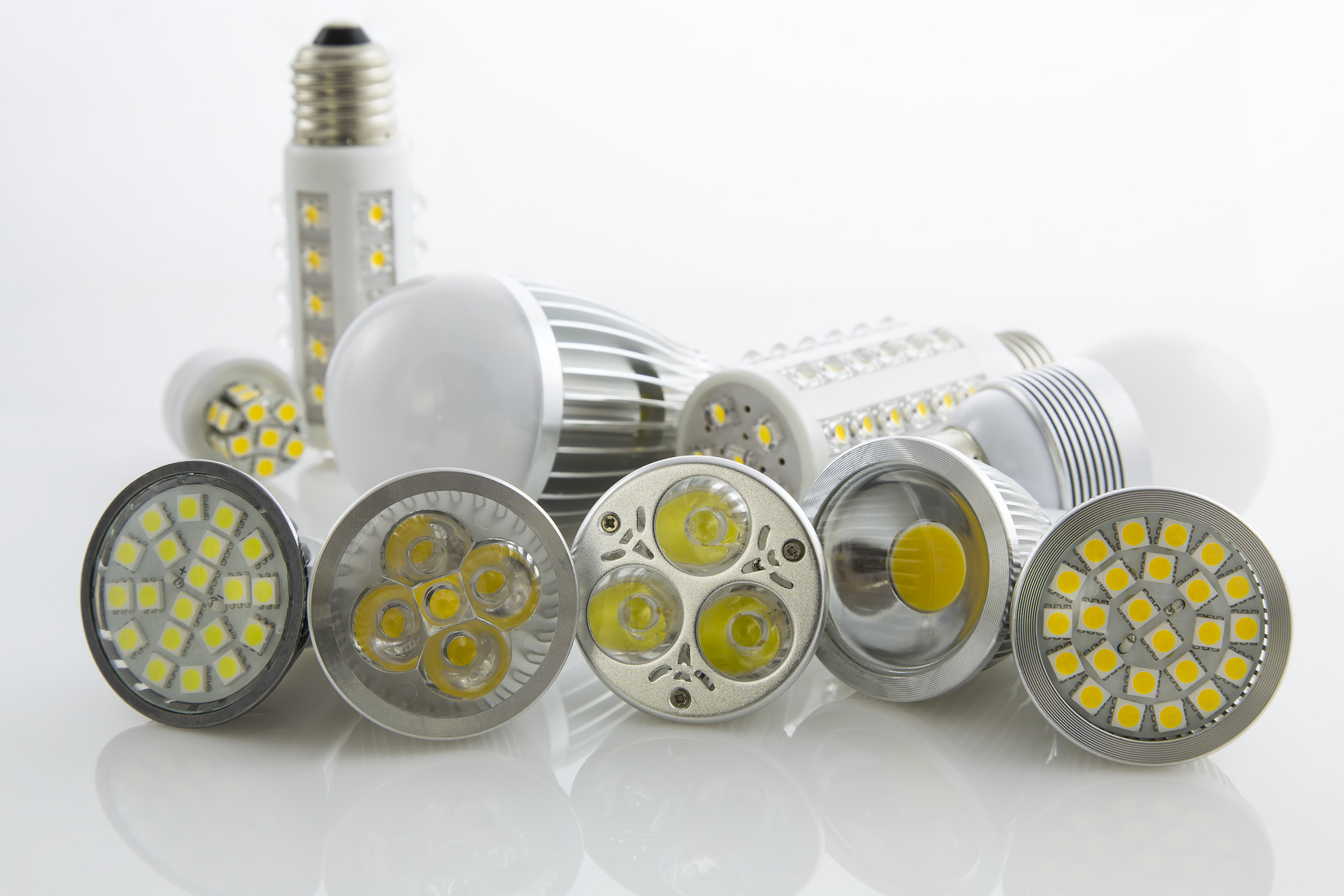
Many LED lamps also had to be rejected.
The Market monitoring through the ESTI is carried out throughout Switzerland and is carried out in accordance with the Ordinance on Low-Voltage Electrical Products (NEV). Electrical products placed on the market for household, office, commercial and industrial use are randomly tested for conformity and safety to ensure that only safe electrical products are made available on the market in Switzerland.
The products inspected were recorded on the occasion of trade fair visits, visits to wholesalers, specialist markets and manufacturers, as well as in the context of inspections on Internet platforms and in print media. Inspections were also carried out on the basis of reports from consumers, competitors and experts from the electrical sector.
A total of 249 products with defects were recorded. Thus, 15% of all inspected electrotechnical products have defects. Of these, 106 products contain safety-related defects.
If there is a danger for the user, the ESTI can prohibit the further marketing of a product. In 2014, 34 sales bans or sales stops had to be issued. Particularly affected in 2014 were various mobile whirlpools from an Asian manufacturer, a wide variety of LED tubes that are not safe to touch, LED lamps and luminaires, unauthorized travel adapters, cotton candy machines and, in general, plugs with inadequate electrical properties on a wide variety of devices. In this context, it should be noted that the marketing of electrical devices with foreign plugs is prohibited in Switzerland.
In 25 cases, retailers and manufacturers as distributors have themselves withdrawn products from the market on the basis of the Federal Product Safety Act (PrSG) and informed ESTI. In 17 cases, the recalls and safety information were published on the website of the Consumer Affairs Bureau (BFK) in cooperation with ESTI. This concerned tumble dryers, electric water heaters, mobile whirlpools, power cords for notebook computers, smartphone power supplies, PCs, travel adapters, fan heaters, sterilizers, lamps and track heaters.
The ESTI recommends all consumers to rely on reputable suppliers with competent customer service in Switzerland when purchasing electrical equipment and to pay attention to legible operating instructions and test marks affixed to the product. Recognized Swiss test marks are, for example, the ESTI safety mark - such devices with safety marks are published at www.esti.admin.ch - and the SEV conformity mark from Electrosuisse. These test marks meet higher standards of product safety than self-declaration with a CE mark and offer added value to consumers and users.
Press release ESTI
Working hours: More absences than overtime
Swiss employees worked 7.7 billion hours last year.
Editorial - May 22, 2015
Home on time? If you place a lot of value on that, you'd better not work in the financial sector.
Swiss employees worked a total of 7.7 billion hours in 2014 - an increase of 1.2 % compared with the previous year. This is reported by the Federal Statistical Office.
Of this, 2.4% was worked as overtime across all industries. However, there are large differences depending on the industry: In the banking and insurance industry, for example, 4.6% of overtime was recorded, while in public administration only 1% of overtime was worked in the same period.
The number of absences during the same period was 3.7%. Most absences were due to health reasons (75% of the total), i.e. illnesses and accidents. Around 10% each were taken up by military and civilian service and maternity leave.
There is a change at Alpiq InTec AG, Security Division in Zurich: Michele Waldeck is succeeded by Rolf Löffel from Telenot.
Editorial - May 22, 2015
Rolf SpoonMichele Waldeck
Rolf Löffel will be the Alpiq division Security in Zurich from June 1, 2015. He has many years of experience in security technology and was most recently head of the Telenot branch in Winterthur.
Michele Waldeck began building up the Security department at the Zurich site ten years ago. During this time, the team has grown to 15 employees. He looks back on a successful and exciting time with many good contacts and interesting projects, says Waldeck, who is looking forward to his new task: He will continue to work for Alpiq and will take over the national function of Product Manager Security from August 2015.
Peter Nebiker is the new SES President
The new president of the Association of Swiss Installers of Security Systems (SES) is Peter Nebiker.
Editorial - May 21, 2015
Peter Nebiker
Peter Nebiker (Siemens), the previous SES-Vice President, was elected unanimously at the SES General Meeting on May 21, 2015. He has been on the board for five years and succeeds Guido Portmann (Securiton), who has headed the trade association for the past eight years. The two security professionals are thus swapping roles, as Portmann will now act as "Vice".
As the association surveyed Industry statistics among SES companies for 2014 shows, the positive growth of recent years has given way to more of a mixed picture. The industry is in a phase of stagnation, said the new president. However, he is optimistic and expects the situation to improve again from 2017.
Nebiker also emphasized that digitalization is a major challenge for the security industry.
There is a threat of a competitive disadvantage
The report "Cloud, SaaS and mobile IT solutions in SMEs 2015" shows that without mobile IT solutions, competitive disadvantages are imminent.
Editorial - May 21, 2015
Will it soon no longer be possible without mobile IT solutions?
Mobile IT solutions will become increasingly important for medium-sized companies in Germany and will significantly shape the work in the companies in the next few years. This is the result of the latest survey by the Frankfurt IT and web experts from DiOmega highlights. Two-thirds of the professionals surveyed (69%) agree that "mobile" will gain strongly in importance, according to the media release. The survey also concludes that despite the wiretapping scandals, demand for cloud or hybrid solutions will continue to grow this year (57% agree). Because SMEs that do not rely on the "third platform" (cloud, big data, mobile) in the medium term will miss out on a decisive competitive advantage, 58% of the experts assume.
Classic business models have had their day
54% of the IT experts surveyed are convinced that SaaS (Software as a Service) and cloud services will replace traditional business models by 2020. Even if, according to a TecChannel survey, only around one third of SMEs are currently using services from the cloud, the positive trend is continuing. A recent study by the consulting firm IDC, for example, shows that the topic of mobility is at the top of the list for 60% of IT decision-makers in SMEs. "Classic licensing models for software are becoming increasingly unattractive for more and more companies. Inflexible, costly and often not very transparent are particularly disadvantageous features," emphasizes DiOmega CEO Dominique Bös.
Wiretapping scandals: short-term obstacle
Bös sees the PRISM, Echelon and other eavesdropping scandals as a serious obstacle to more growth in SaaS and cloud services in the short term. This means that a current study of the National Initiative for Information and Internet Security e.V. (NIFIS) concluded that 84% of companies in Germany are very uncertain about whether their data is still safe in the "digital cloud". According to the report, loss of control over one's own data (73%), internal and external hacker attacks (71%) and one's own ignorance of the existing risks (89%) are currently the main dangers for German businesses in cloud computing, the provider writes. "When SMEs are more certain about what happens to their data in the IT cloud, their willingness to use mobile solutions increases again," explains CEO Bös.