Challenge smoke extraction

"The challenge of smoke extraction" - under this title, the companies Belimo, Bosch-Sicherheitssysteme, Schmidlin and Trox Hesco as initiators recently invited to a half-day specialist forum. Over 160 interested parties accepted the invitation to Olten and Winterthur. Increasingly complex and higher buildings require modern fire protection concepts on the one hand and innovative and technical solutions on the other hand. Only if smoke extraction [...]


Increasingly taller buildings demand modern fire protection concepts and innovative solutions.

"The challenge of smoke extraction" - under this title, the companies Belimo, Bosch-Sicherheitssysteme, Schmidlin and Trox Hesco as initiators recently invited to a half-day specialist forum. Over 160 interested parties accepted the invitation to Olten and Winterthur.

Increasingly complex and higher buildings require modern fire protection concepts on the one hand and innovative and technical solutions on the other. Only if the smoke extraction system is correctly planned and implemented as a whole can visibility be maintained in the event of an incident, thus saving lives. The initiators had therefore compiled a consistent mix of topics: starting with the legal, normative part, through the planning, organizational area, to the technical solutions of smoke extraction and the integral tests.

The reason for the event is not least the fact that a lot has changed on the regulatory side in the field of smoke extraction in 2015. New fire protection regulations have been in force since January 1, 2015: On the one hand, the aim was to optimize the cost-benefit ratio and, on the other, to liberalize the regulations - without compromising on personal protection. The scope and freedom for planners and builders have therefore become greater, but the responsibility has increased. Seen as a whole, the new fire protection regulations are a benefit and advantage for the building owner.

There is also a lot going on with regard to the Construction Products Regulation. The participants were also competently updated on this topic. Why the topic of smoke extraction was deliberately chosen for the half-day expert forums is also constantly reflected in the results on the market. Because there is obviously a discrepancy between the actual target state and the effective ACTUAL state. What might be the reason for this? The closing bouquet, a presentation by Bernd Konrath, managing partner of the Institute for Industrial Aerodynamics in Aachen, showed very well where action is needed and where there is potential for optimization.

More info about the initiators of the expert forum:

www.belimo.ch

www.bosch-sicherheitssysteme.ch

www.schmidlinag.ch

www.troxhesco.ch

Search court rulings

According to the operator, the NRGlex search engine quickly and inexpensively consults judgments from all cantonal and federal courts.

NRGlex is looking for court decisions in Switzerland.

Semantic search, they say, is an attempt to overcome the limitations of the technology of traditional search engines (syntactic, like the best known on the Internet), which only identify the individual words within a text without looking at the context in which they are used: This requires using exactly the same words that were used in the original document, they say.

With the NRGlex search engine you can enter sentences in either German, French or Italian. The tool is a useful tool for lawyers, notaries, corporations, hospitals, and municipal and cantonal authorities, it says.

The tool was created by a group of legal scholars and computer scientists.

An emergency ventilator that talks

A new emergency ventilator talks to lay responders to help them deploy.

The emergency ventilator is intended to replace mouth-to-mouth resuscitation in the future.

Researchers at the University of Rostock (Germany), together with the company Sensatronix GmbH, have developed a Emergency ventilator developed that linguistically supports emergency responders in their efforts to save lives.

Unlike conventional ventilators, this device is intended to be self-sufficient, i.e. independent of a fixed gas and power supply, and can be operated by laypersons.

The planned area of application is comparable to that of the automated external defibrillators, which are nowadays available in many public places for emergencies. These devices automatically regulate the delivery and dosage of an electric shock and thus provide an untrained first aider with a useful aid in the event of cardiovascular failure.

The novel lay emergency ventilator is designed to replace mouth-to-mouth resuscitation and provide a patient with oxygen quickly and reliably in an emergency. Similar to the layman's defibrillator, the first aider is given acoustic instructions for assistance. In both cases, early help significantly increases a patient's chances of survival. What's more, by using these automated devices, lay first responders cannot cause more damage to the patient than would occur if the devices were not used.

View cyber attacks in real time

A world map highlights cyber attacks worldwide and provides country of origin, target country and attack type with daily statistics.

cyber-attacks-in-real-time-displays-it-security

The rapid pace and global scale of cyber attacks is almost incomprehensible. One tool is intended to provide more clarity: security provider Check Point delivers the "ThreatCloud World Cyber Threat Map" threat data and attack trends from a global network of threat sensors. The corresponding database reportedly contains over 250 million IP addresses scanned for bot detection, over eleven million malware signatures and over 5.5 million infected websites. Every day, millions of types of malware are identified with the map tool, it said. In addition, the tool displays key daily threat statistics, including:

  • The top ten countries from which attacks originate
  • The top ten countries that are targets of the attacks are
  • Types of attacks (bot communication, access to malicious resources, malicious file transfer, spams).
  • Total daily attack count
  • Country-specific data showing infection averages and most common attack types per week and month

Quickly encircled

A brief review of the May Day festival in Zurich.

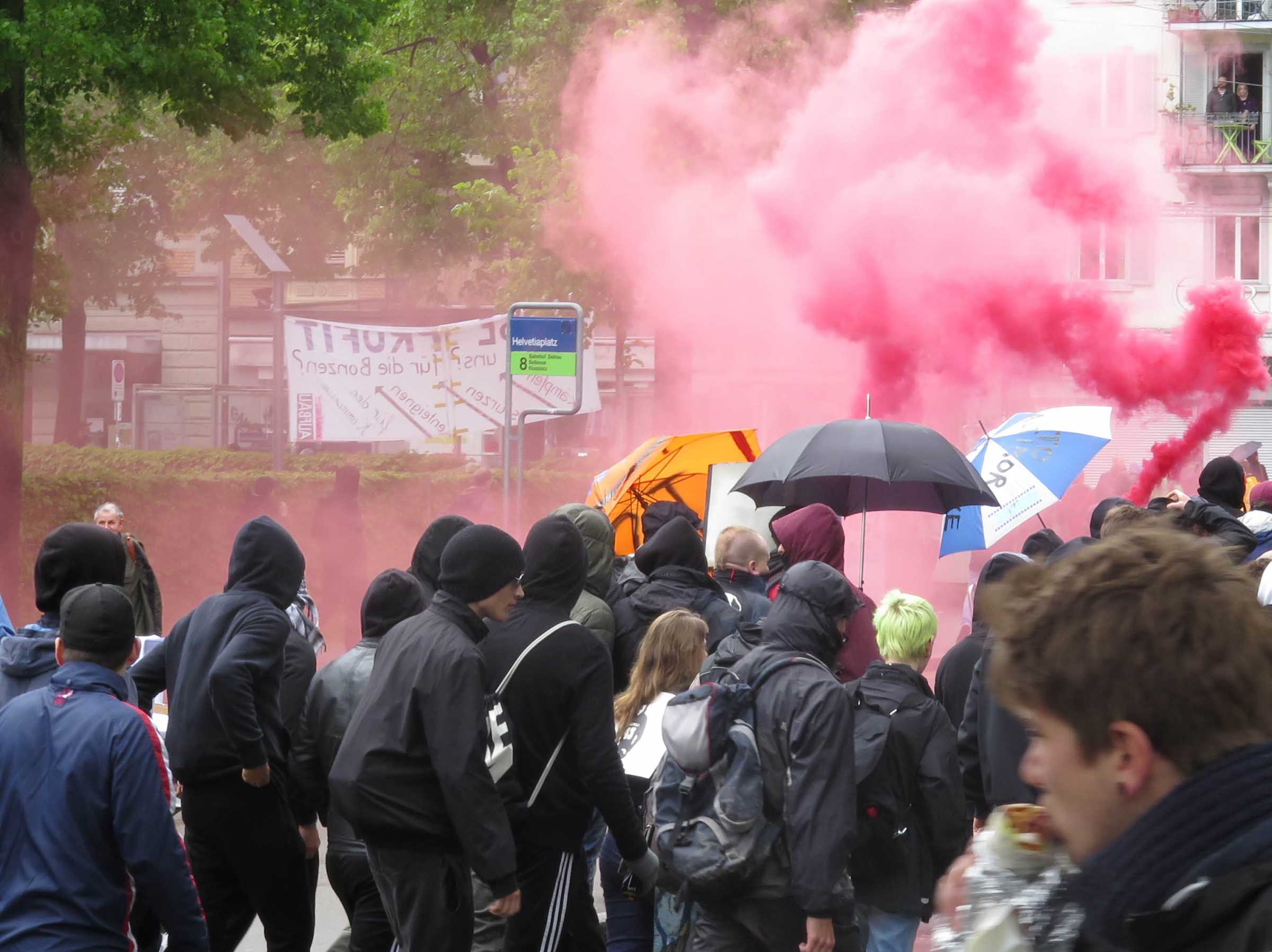
As every year, also on this year's 1st May Festival, on Labor Day, an "aftero" was announced in Zurich after the official event. Shortly after 3 p.m., a larger number of partly hooded people gathered on Helvetiaplatz. The police forces showed a strong presence and had cordoned off the surrounding streets in no time and surrounded the demonstrators. The police were not provoked by the occasional throwing of stones and bottles - riots were prevented. Zurich's main train station and various cantonal buildings were under heavy police protection.

Unlike in Istanbul, Hamburg or Milan, for example, the traditional public festival in the Zurich Zeughausareal, but also elsewhere in Switzerland, went off peacefully. The cooperation between the police and the May Day Committee and the trade union federation went well, as the media service of the Zurich Cantonal Police writes. According to the press release, 58 people were arrested primarily for the purpose of clarifying their identity and most of them were released. In addition, several expulsions were issued. For some people, prohibited pyrotechnic objects, masking material, batons, but also a homemade explosive device were seized.  Source: Stapo/SF

View of Helvetiaplatz, where a small fire is lit. Photos: R. Strässle

Third: Transaction structure and valuation of Dorma+Kaba

What does the new Dorma and Kabe holding company look like? Who brings in what and what are the new shareholding ratios?

Christine Mankel, Dorma family shareholder

Shareholding structure:

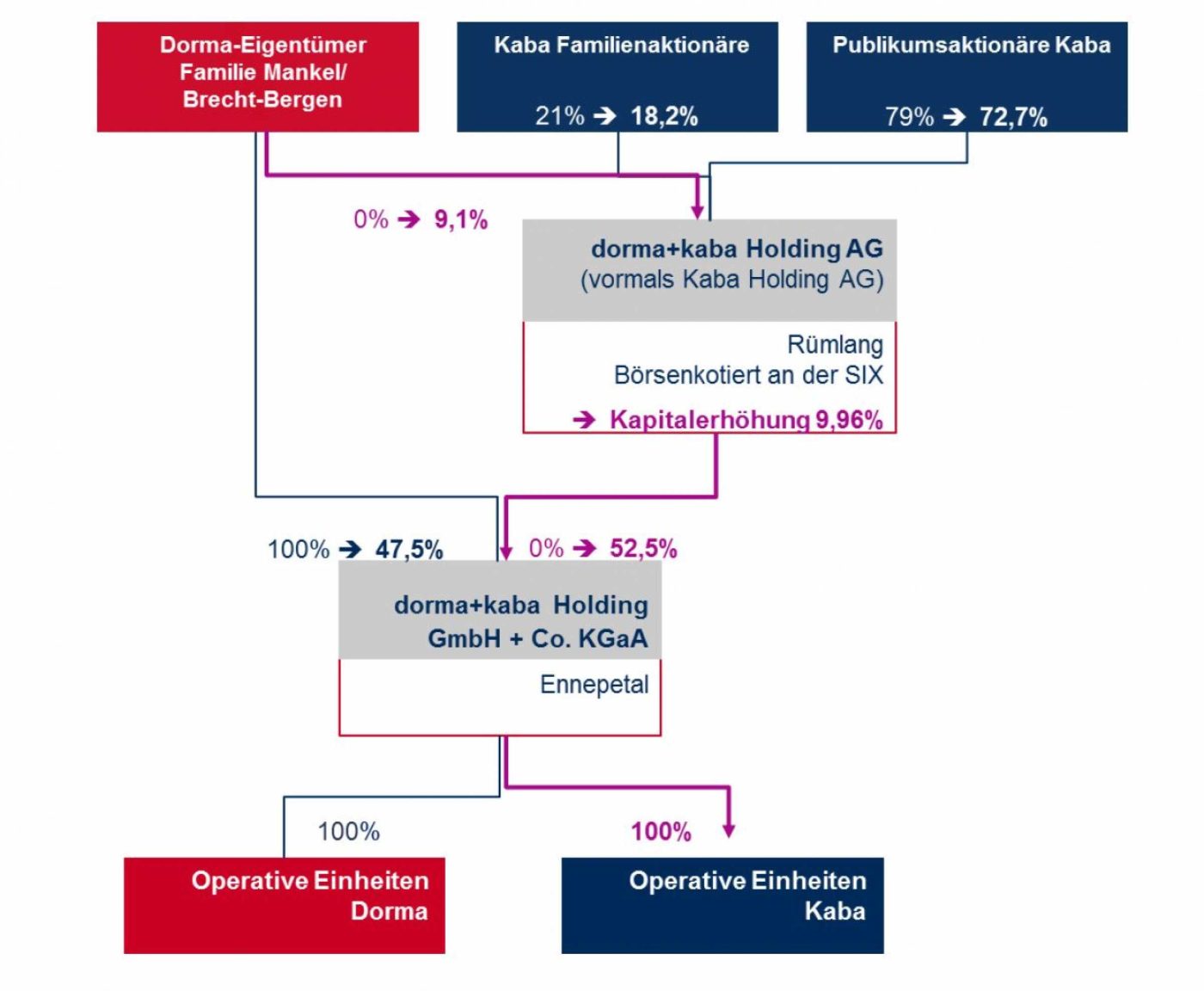
Kaba with 52.5% and Dorma (Mankel/Brecht-Bergen family) with 47.5%.

Following approval of the merger by Kaba's shareholders - the extraordinary general meeting will take place on May 22 - Dorma's owner family, the Mankel/Brecht-Bergen family, is subscribing for 380,000 registered shares with a par value of CHF 0.10 each from Kaba's authorized capital. The price is reported to be CHF 178.4 million, corresponding to the average volume-weighted Kaba share price of CHF 519.45 over the last 90 trading days (as of April 28, 2015, after market close) minus CHF 50 per share as compensation for the new shares' lack of entitlement to receive the planned special dividend. After this capital increase, the Mankel/Brecht-Bergen family holds 9.1% and the existing Kaba family shareholders 18.2% in Kaba Holding.

Upon completion of the Merger, Kaba Holding will contribute its operating activities to today's Dorma Holding, in which the operating business will be combined, and will receive a controlling interest of 52.5% therein. The Mankel/Brecht-Bergen family will accordingly hold 47.5% in today's Dorma Holding and in the combined business, respectively.

The holding company dorma+kaba, which will be listed on the Swiss stock exchange, will be the holding company of the new group and will be responsible for its strategic, operational and financial management and will fully consolidate the combined business.

What does the evaluation look like?

According to the information provided, Dorma and Kaba initially have equivalent valuations. Based on the agreed transaction structure, Dorma will be contributed to the combined company at an EV/Ebitda multiple of 10.1 and Kaba at 12.2. Taking into account the cash remaining with Kaba Holding of approximately CHF 190 million, this results in ownership ratios in the combined business of 52.5% by Kaba and 47.5% by the Mankel/Brecht-Bergen family, respectively. An independent fairness opinion by N+1 Swiss Capital for the attention of the Board of Directors of Kaba Holding confirms that the envisaged ownership structure is fair and balanced from a financial point of view, according to the report.

In return for relinquishing the majority in their business, the Mankel/Brecht-Bergen family receives the right to purchase shares in the current Dorma Holding at market value in the event of a change of control of dorma+kaba Holding in order to regain its majority. In the event of an imminent change of control, the shareholders of dorma+kaba Holding can revoke this right by a three-quarters majority until the end of 2018 and by a simple majority from 2019.

Strong anchor shareholder group

The family shareholders of Dorma and Kaba, who together hold 27.3% in the new holding company dorma+kaba after approval, will form a strong anchor shareholder group and have signed a long-term pooling agreement, the duo points out. Among other things, the two partners have granted each other mutual pre-emption rights and also undertake to sell a block of shares of 27% or larger to a third party only if the latter makes a public takeover offer to all shareholders at the same price per share.

Christine Mankel and Stephanie Brecht-Bergen (née Mankel), shareholders of Dorma: "We are fulfilling our obligation as family entrepreneurs and want to accompany the new group as long-term oriented anchor shareholders. By subscribing to new shares in Kaba, we are simultaneously increasing our entrepreneurial commitment."

Second: Kaba holds extraordinary AGM

The mega-deal in the security industry is not yet signed and sealed: Kaba will therefore hold an Extraordinary General Meeting on May 22, 2015.

Riet Cadonau, current CEO of Kaba, has been nominated as CEO of the new dorma+kaba group.

At the Extraordinary General Meeting of Kaba is pending the approval of the Merger of Dorma and Kaba an. The shareholders and in particular the non-anchor shareholders are invited to confirm that no obligation to make an offer arises in the context of the present transaction ("opting-out" limited to the present transaction), as Kaba writes. Furthermore, the Board of Directors proposes the cancellation of the current share transfer and voting right restrictions of 5% as well as further amendments to the Articles of Association. In addition, the proposal is made to distribute a special dividend to shareholders from reserves from capital contributions in the amount of Fr. 50 per share. According to the information provided, this corresponds approximately to the amount of funds that will flow to the company from the authorized capital as part of the capital increase.

Christine Mankel and Stephanie Brecht-Bergen, shareholders of Dorma, and Hans Gummert, Chairman of the Supervisory Board of Dorma, will be proposed for election to the Board of Directors of the future dorma+kaba Holding. Thomas Pleines, a member of Kaba's Board of Directors since 2011, had agreed to step down from the Board.

The resolutions of the Extraordinary General Meeting will become effective upon completion of the merger. Subject to the approval of the shareholders and the competition authorities as well as other customary conditions, this is expected to take place in the third quarter of 2015.

The latest issue of the trade journal "SicherheitsForum" features a Interview with the CEO of the Kaba Group, Riet Cadonau. The editors conducted this interview before the announcement of the merger of Kaba and Dorma.


First: Mega deal in the security industry

The Swiss Kaba Holding AG, based in Rümlang, and the German family-owned company Dorma Holding want to merge. The result would be the dorma+kaba group. A corresponding transaction agreement was signed yesterday evening. The deal still has to be approved by shareholders.

The Chairman of the Board of the new holding company will be Ulrich Graf, currently Chairman of the Board of Kaba.

For Ulrich Graf, Chairman of the Board of Directors of Kaba, it is clear: "By combining the two strong brands Dorma and Kaba a leading company in the security industry is created. The shareholders stand for a long-term orientation - this is also a real competitive advantage in our dynamic industry." Dorma offers access solutions and is one of the market leaders in automatic, glass fittings and door locking technology. The same applies to Kaba in the field of access control, store floor data collection and key systems.

The result is the global top 3 in the security and access league.

With pro forma sales of more than 2 billion Swiss francs, around 16,000 employees and locations in 53 countries, the two merged companies with the new joint holding company move into the global top 3 of the highly fragmented market for security and access solutions. Hans Gummert, Chairman of the Supervisory Board of Dorma: "With the merger of our globally established companies, we are significantly strengthening our market position. Not only do we share over a hundred years of entrepreneurial tradition and the same values, but we also largely agree on our strategies."

Dorma and Kaba are an ideal match

The technological expertise, the products and the distribution channels of Dorma and Kaba would ideally complement each other, it is said. The joint distribution and service network, cross-selling and positioning as a "one-stop store" for security and access to buildings will open up considerable additional growth potential for the combined company. Thomas P. Wagner, CEO of Dorma: "Together with Kaba, we are taking a big step forward. We are expanding our product range, strengthening our global presence and increasing our innovative power. This will allow us to take advantage of opportunities offered by megatrends such as urbanization and digitalization faster and better."

dorma+kaba will have production facilities in all major markets of the industry and will accelerate its global expansion with increased presence especially in Europe, America and Asia-Pacific, it is emphasized.

Substantial increase in value

Riet Cadonau, CEO of Kaba: "Dorma and Kaba are ideal partners in every respect and a convincing strategic fit. With the planned merger, we are creating additional opportunities for sustainable profitable growth - with corresponding added value for our customers, partners, employees and shareholders."

Over the next four years, the new duo is targeting sales growth of 6 to 7% (in local currencies) per year. Due to higher purchasing volumes, optimized infrastructure costs as well as efficiency gains, cost synergies of CHF 60-70 million per year are expected to be fully effective in the fourth year after the merger, according to the statement. One-time implementation costs are estimated to total the full cost synergies for one year.

Who will be what in the new group?

Ulrich Graf, the current Chairman of Kaba, will chair the Board of Directors of the new group. CEO is to be Riet Cadonau, the current CEO of Kaba. The designated CFO is Bernd Brinker, CFO of Dorma. The management bodies of the group are to be as balanced as possible, according to those responsible.

The locations in both Rümlang and Ennepetal, Germany, will play an important role in the joint company. Rümlang will be the corporate headquarters of dorma+kaba Holding, while Ennepetal, as the headquarters of the future "Access Solutions DACH" division, will be responsible for business in the German-speaking countries.

The merger also entails a merger of jobs: there is talk of a total reduction of around 5% of the workforce, spread over four years.

More information about the Transaction structure and valuation as well as the shareholding relationships between Kaba and the Dorma family of owners are here available.

The mega deal still has to be approved by shareholders at a Extraordinary General Meeting be approved by Kaba.

The CFO of the new holding company will be Bernd Brinker, currently CFO of Dorma. CEO of the new holding company will be Riet Cadonau, current CEO of Kaba.


New epidemic law: no compulsory vaccination

The Federal Council decides to enact the Epidemics Act as of January 1, 2016. The law does not provide for compulsory vaccination.

With the Epidemics Act, communicable diseases can be better controlled.

The Epidemics Ordinance describes the legal provisions for combating transmissible human diseases. The Ordinance on Microbiological Laboratories sets out the requirements and procedure for obtaining a permit to operate such laboratories. The consultation on the ordinances lasted from July to October 2014. The comments are summarized in a hearing report.

60 % of the voters approved the revision of the Epidemics Act in September 2013. The responsibilities of the federal government and the cantons will be regulated more precisely in the future. The Confederation will have a stronger role in management, target setting, supervision and coordination, while the cantons will remain responsible for enforcement. As a result, crisis situations can be prepared more efficiently and managed better. In addition, epidemics can be combated more effectively.

The new law also creates the conditions for taking uniform, efficient measures throughout Switzerland to prevent, monitor and combat antibiotic resistance and infections in hospitals and nursing homes. It does not provide for compulsory vaccination.

10 years MELANI

The reporting and analysis center MELANI is ten years old and has published its 20th semi-annual report: it not only highlights the most important events of recent months, but also takes a look at the development of cybercrime over the past decade.

10-year-melani-it-security

In the last ten years, the number of Internet users has increased enormously, as has the number of platforms and services. New services and applications created additional opportunities to find and also exploit vulnerabilities. This also affected criminal structures and was exploited accordingly. Thus, a true underground market has developed in recent years, where everything can be procured to carry out an attack. Nowadays, various states also have a great interest in using the Internet for espionage and surveillance methods. Compared to the first MELANI Semi-Annual Report from 2005, however, it can be seen that the topics are largely the same: Even then, the focus was on targeted espionage attacks, phishing, DDoS, defacements and social engineering.

New extortionist malware

In the second half of last year, the landscape of extortionist malware has become even more diverse. Following the Cryptolocker encryption Trojan, a new malware called Synolocker has emerged. What is significant about Synolocker is that the attackers only had to exploit a vulnerability in a particular file server to trigger an infection. Cryptolocker's infection was more elaborate, as it took user interaction to inject the Trojan. Attackers use the Trojan to penetrate systems and encrypt the data in order to extort money from the victims.

A new extortionist trend is also moving in the direction of hackers gaining access to sensitive data and threatening the affected company with publication unless a certain amount is paid. In other cases, even the entire database of an Internet presence is encrypted, rendering the website unusable until the extorted amount is transferred.

Poorly protected systems

At first glance, attacks on poorly protected systems such as webcams, wireless networks or content management systems for creating websites only leave the operator or content owner with a loss. Often forgotten is the fact that compromised systems can be misused for phishing attacks, distributing malware or sending spam, even with contaminated attachments or links to malicious websites. This semi-annual report cites specific examples and makes recommendations on how to prevent impending dangers.

Smart and safe?

The trend toward operating everyday objects, cars and houses remotely using smartphones is steadily increasing. Even people's state of health is being transferred to the Internet through the use of health apps. But with all the convenience comes exposure to the dangers and risks of the Internet, and people should protect themselves accordingly. The second semi-annual report for 2014 MELANI provides insight into the potential threats in the new smart world.

Press release MELANI


The topics have remained largely the same: espionage attacks, phishing, DDoS, defacements, social engineering.
(MELANI.)


Dangerous goods transport analyzed

The Federal Office of Transport (FOT) has analyzed where transports of dangerous goods on the Swiss rail network can lead to environmental risks. Recently, the rough analysis with the findings was published.

Transport of dangerous goods by rail: Environmental risks analyzed for the first time.

In the case of sections of line with increased risks, the railroads must carry out further clarifications in close cooperation with the authorities, as the FOT writes. Where necessary, they must examine and implement measures to reduce the risk.

Traffic routes on which hazardous goods are transported are subject to the Ordinance on Major Accidents. This prescribes safety measures to protect the population and the environment. While the risks to the population have been recorded for some time, the FOT, in close cooperation with the railroads, has now also systematically assessed the risks to the environment for the first time and documented them in a report. According to the FOT, Switzerland is thus taking on a pioneering role throughout Europe.

The report shows on which sections of the route there are increased risks from the contamination of ground and surface waters. The environmental risks were analyzed on the basis of characteristic water pollutants with different behavior. On the 3652-kilometer standard gauge network, a total of 42 sections of surface water and a total of 10 kilometers of groundwater have been identified for in-depth examination. The railroads will now analyze the affected sections together with the FOT, the Federal Office for the Environment and the cantonal accident management authorities. Where necessary, the implementation of risk-reducing structural or organizational measures will be examined, such as slide valves in the drainage system.

Noise Day: Respect quiet times!

People who do not sleep enough are less efficient and more prone to accidents. Today's Noise Day therefore calls for consideration of night owls towards local residents.

Noise at night robs you of sleep - and that can be dangerous.

Today's Noise day calls for consideration of the sleeping needs of local residents, even when going out.

Night owls, for example, should keep quiet outside during the 10 p.m. and 6 a.m. nighttime quiet hours, especially when smoking outside the door or leaving the premises. The organizers and businesses are also asked to keep music and loud movies indoors during this time.

This serves not only the quality of life of residents, but also their health and safety: On the one hand, sufficient sleep is indispensable for physical and mental health, according to studies. For example, a persistent lack of sleep increases the risk of diabetes and depression, and too little sleep thwarts efforts to lose weight.

On the other hand, fatigue also increases the risk of accidents, whether on the way to work, during leisure time or at work itself. A study from Austria, for example, shows that every third traffic and work accident was caused by a lack of sleep. This clearly shows that sleep quality is not a trivial matter.

get_footer();